Walk into a gas station or smoke shop, and you’ll find tablets, shots, and gummies labeled as Kratom that have almost nothing in common with the leaf. They’re sold next to the energy drinks, marketed as a quick lift, and priced like an impulse buy. Most of them aren’t natural Kratom at all. They’re synthetic Kratom, and the difference is worth understanding before you put one in your cart.
Quick Answer: Synthetic Kratom is shorthand for products built around concentrated or lab-converted 7-Hydroxymitragynine (7-OH), the trace alkaloid that makes up roughly 0.05% of the natural leaf. Real Kratom is the whole dried leaf of Mitragyna speciosa, with Mitragynine as its main alkaloid. The two behave differently and are now treated differently by federal regulators.
When people say “synthetic Kratom,” they’re almost always talking about products built around concentrated or lab-made 7-Hydroxymitragynine, usually shortened to 7-OH.
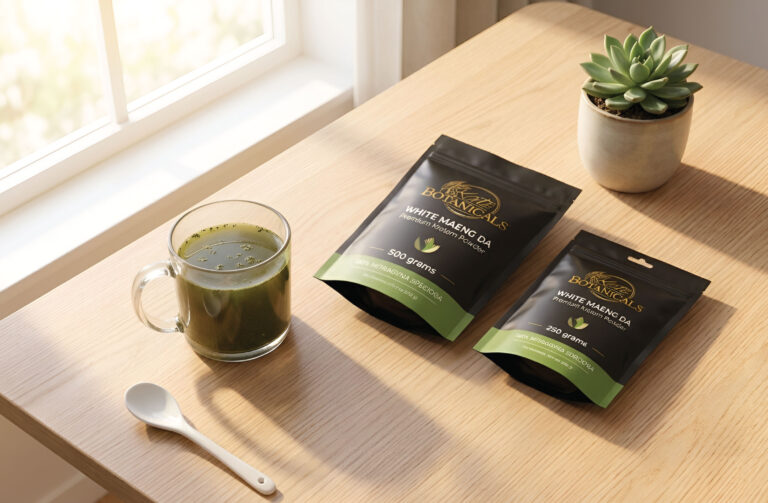
There’s a big difference between a product sold as 7-OH and the pure Kratom leaf powders, extracts, and shots you can buy here. To be upfront, we don’t sell any adulterated or synthetic Kratom at Kats Botanicals. Nor will we. Let’s talk about why that matters.
What “Synthetic Kratom” Actually Means
Synthetic Kratom is any product that concentrates or chemically converts 7-Hydroxymitragynine far beyond the trace amount found in the natural leaf. Natural Kratom comes from the dried leaf of Mitragyna speciosa, a tree in the coffee family grown in Southeast Asia. The leaf contains dozens of kratom alkaloids, most abundantly Mitragynine (MIT), which makes up roughly 1 to 2 percent of the dried leaf. 7-Hydroxymitragynine (7-OH) is also in the leaf, but at around 0.05 percent, a trace amount.
Synthetic Kratom products take that trace compound and concentrate it far beyond anything the plant produces on its own, sometimes through a chemical conversion step in a lab. The result is a product that may carry the word “Kratom” on the label while behaving like a different substance.
Real Kratom Extracts vs Synthetic Kratom Extract
A bottle labeled “Kratom extract” sounds like a stronger version of the leaf, and in many cases, it is. The alkaloids are pulled from real Kratom and used to fortify other Kratom products. In this use, Kratom extract products make sense. Even when you’re making Kratom teas, you’re extracting real alkaloids from real Kratom leaf or powder. You get Mitragynine, minor alkaloids like Speciogynine and Paynantheine, and trace amounts of the very strong 7-OH found in natural Kratom.
Here is where critical thinking matters when deciding if a product is made with safely extracted Kratom alkaloids, or something else. Since natural 7-OH is so scarce in natural Kratom, astronomically high concentrations of it are unlikely to be profitable to source from leaf alone. That brings high-strength 7-OH tablets (and the like) into question, and fairly. The overblown potency suggests lab-adulteration, signals safety issues, and is why Kratom experts insist on separating 7-OH products from real Kratom.
Natural Leaf vs Synthetic 7-OH
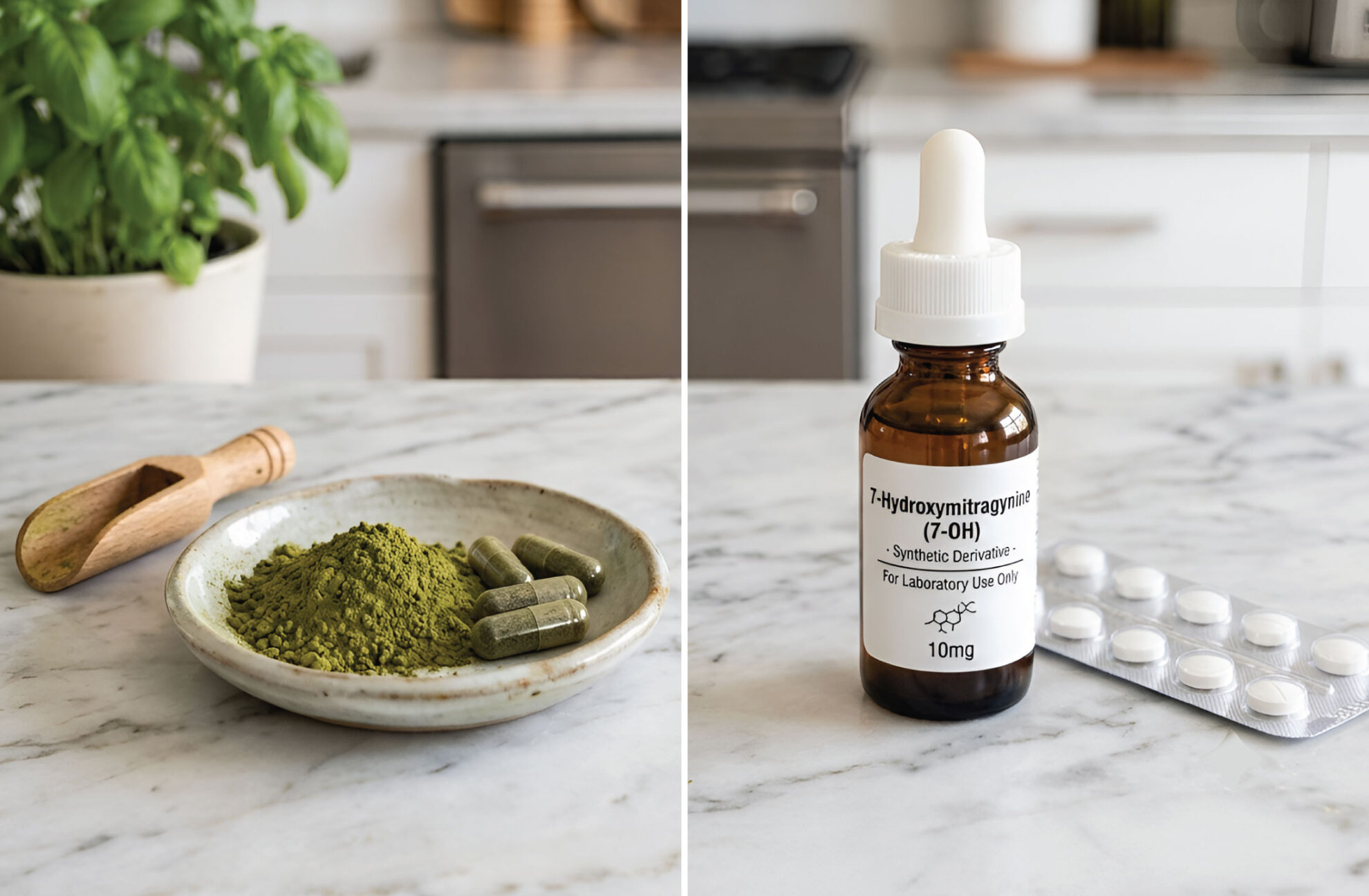
Natural leaf Kratom and synthetic 7-OH products differ in source, dominant compound, concentration, format, and federal status. The cleanest way to see those differences is side by side.
| Natural leaf Kratom | Synthetic 7-OH products | |
| Source | Whole dried Mitragyna speciosa leaf | Concentrated or lab-converted 7-OH |
| Main compound | Mitragynine, with the full alkaloid range | Isolated, concentrated 7-OH |
| 7-OH level | About 0.05% of the leaf | Many times higher than the plant |
| Typical format | Powder, capsules, leaf-based products | Gas-station tablets, shots, gummies |
| Federal status (early 2026) | Not a controlled substance | Under active scheduling review |
Pharmacologically, 7-OH binds to the same opioid receptors that drugs like morphine act on. Researchers have measured 7-OH as substantially stronger than both morphine and Mitragynine at those receptors; in vitro studies report 7-OH binding affinity for mu-opioid receptors in the range of 7.2 to 70 nM, with 7-hydroxymitragynine showing roughly 9-fold higher MOR affinity than mitragynine. In a whole leaf, the trace amount and the surrounding alkaloids keep that activity in check. Strip it out, concentrate it, and you’ve removed the brakes. That’s why regulators treat the two so differently.
Learn more:7-OH vs Kratom
What Synthetic Kratom Is Used For
Synthetic Kratom is a fast-growing market even as lawmakers in many states move to ban the compound. The products’ fast-acting potency is largely their appeal.
The Pitch
The selling point for high-7-OH products is a fast, strong effect. They often come in formats built for speed, like sublingual or chewable tabs and rapid-dissolve tablets that move the compound into the bloodstream within minutes. Vendors tend to pitch them for pain, energy, mood, or easing off other substances. Whether any of that holds up under scrutiny is a different question; the FDA has stated that concentrated 7-OH products have not been proven safe or effective for any use.
The Problem
A fast, strong opioid-like hit that fades quickly is the exact profile that encourages taking more, sooner. Health officials have flagged this redosing pattern as a driver of dependence. Risks of dependence, medical complications, and overdose are all real concerns, which is why premium Kratom products start with the whole leaf rather than an isolated alkaloid.
What Synthetic Kratom Is Called
If you’re trying to spot these products, the names help. The compound itself is 7-Hydroxymitragynine, shortened to 7-OH or 7-hydroxy on labels and in marketing. Media coverage has taken to calling the category “gas station heroin,” a label also applied to other unregulated store-shelf substances, so it’s a description of where these products are sold more than a precise chemical name.
Watch for products that lead with a 7-OH percentage or milligram count as the headline feature, or that use “extract” and “enhanced” without a lab report to back up what’s inside. A real extract from a reputable source will tell you its alkaloid breakdown. A synthetic product usually leans on the number alone.
Why Regulators Are Cracking Down
Federal and state regulators are tightening rules on concentrated 7-OH because of its opioid-receptor activity and the redosing risk built into how the products are sold. The action targets the isolated compound, not the leaf.
Federal Action
Federal attention ramped up through 2025. On July 15, 2025, the FDA sent warning letters to seven different companies for the illegal marketing of products containing 7-Hydroxymitragynine (7-OH), a naturally occurring chemical component of Kratom. The letters cited unapproved drug claims and the illegal practice of selling 7-OH as a dietary supplement.
Part of what drove that scrutiny was the Kratom industry itself. Companies that sell natural leaf had been urging the FDA to act on concentrated 7-OH, and the American Kratom Association has lobbied at the state level to restrict synthetic 7-OH while keeping the leaf legal. Two weeks after the warning letters, the FDA went further: on July 29, 2025, the agency recommended a scheduling action to control certain 7-hydroxymitragynine products under the Controlled Substances Act, specifically targeting 7-OH as a concentrated byproduct of the kratom plant rather than natural kratom leaf products.
The State Patchwork
The picture heading into 2026 is uneven. As of early in the year, 7-OH had not been formally added to the federal Schedule I list. Under the CSA, the Drug Enforcement Administration is reviewing the FDA recommendation and has the final authority on scheduling, which requires a rulemaking process that includes a period for the public to provide comments before any scheduling action is finalized. A March 2026 congressional letter pressed the DEA to use emergency authority to move faster.
States haven’t waited. Florida enacted emergency rules on concentrated 7-OH, Arizona capped allowable 7-OH content, and a handful of states ban Kratom in all forms. Whole-leaf Kratom, meanwhile, remains legal at the federal level. The legality of Kratom still varies by state, so checking your local rules matters regardless of which product you’re looking at.
How to Tell Natural Kratom From Synthetic
Telling natural Kratom from synthetic 7-OH products is straightforward once you know what to look for: source, lab report, vendor standards, and sales channel. Each of those tells you something the marketing won’t.
- Buy the leaf, not the isolate. Powders and capsules made from whole leaf are the natural product. Tablets and shots headlining a high 7-OH number are not.
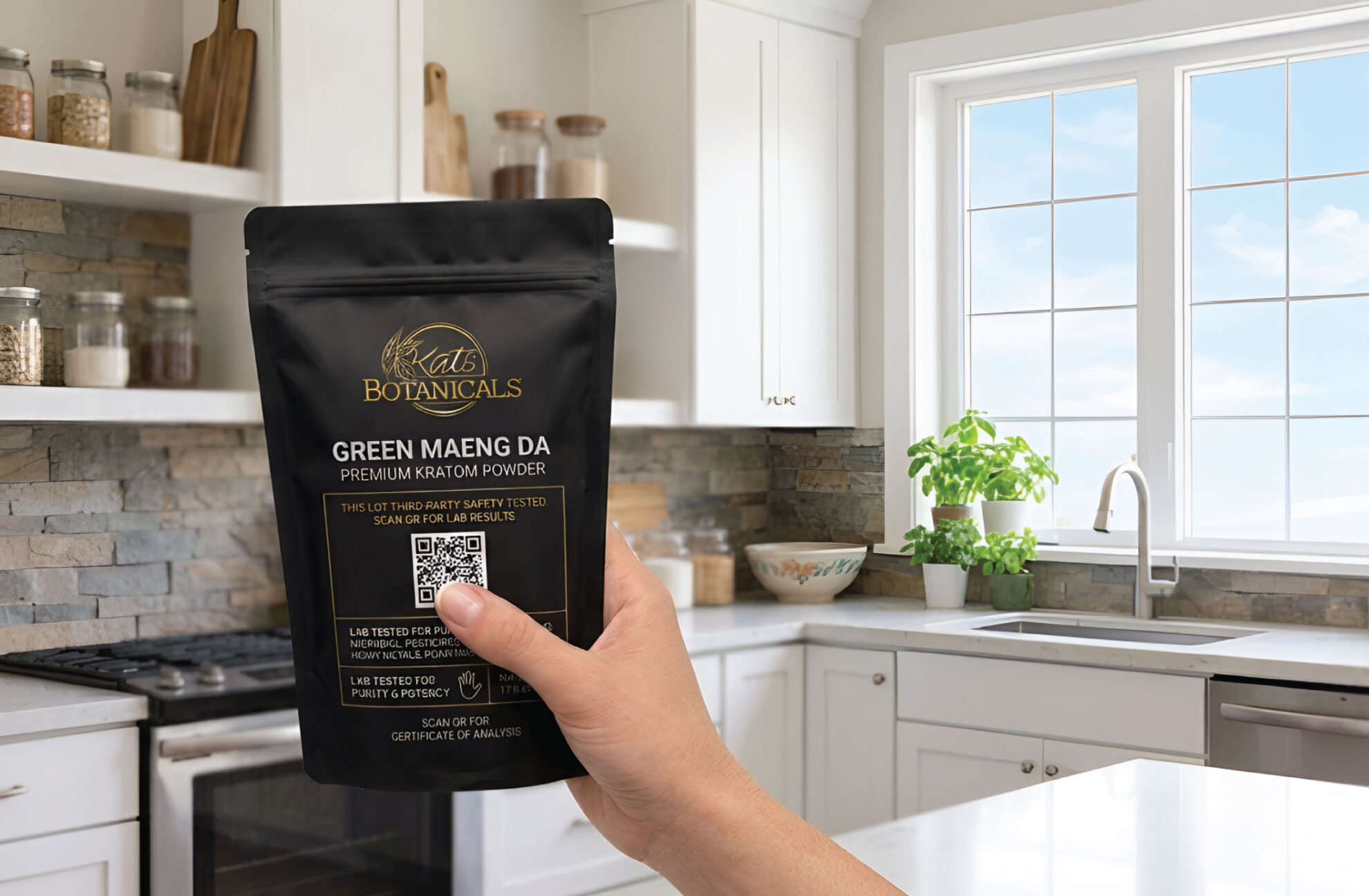
- Demand a lab report. Every Kats Botanicals product carries a QR code that pulls upthird-party lab testing for that batch, screened for heavy metals, pathogens, and alkaloid content.
- Check the vendor. We follow the American Kratom Association’s GMP standards. A gas-station display case of products does not.
- Be skeptical of the sales channel. Natural Kratom from a reputable source doesn’t need to live next to the register at a convenience store.
The reasoning here is simple, and it doesn’t require trusting anyone’s marketing. A lab report tells you what’s actually in the product. If a seller cannot or will not show you one, that absence is your answer. For a deeper rundown on what good test results look like, see our guide on how to read kratom lab test results.