Kratom’s legal footing in Ohio moved twice in a single year, which is enough to leave any regular buyer unsure whether the powder in their cabinet still counts. The short version is clearer than the headlines make it look, once you know where the line falls. And the line isn’t drawn through kratom in general. It’s drawn around what form a product takes and how it’s sold.
Quick Answer: Natural leaf and powder kratom is legal to buy, possess, and use in Ohio as of October 2026. The Ohio Board of Pharmacy’s own consumer and retailer notice spells this out directly: natural kratom in its vegetation form, whole or ground dried leaf, is not a Schedule I controlled substance under the state’s rule, and that holds even for leaf containing trace amounts of 7-OH. The line was drawn around processed and concentrated products, not the plant itself. What’s restricted is processed, synthetic, or concentrated kratom sold as a food, drug, gummy, drink, or dietary supplement, especially products high in 7-hydroxymitragynine (7-OH). That split comes from an Ohio Board of Pharmacy notice, a DeWine executive order, and an August 2026 Franklin County court ruling that together kept the restriction in place.
The Dividing Line: Natural Leaf Versus Processed Products
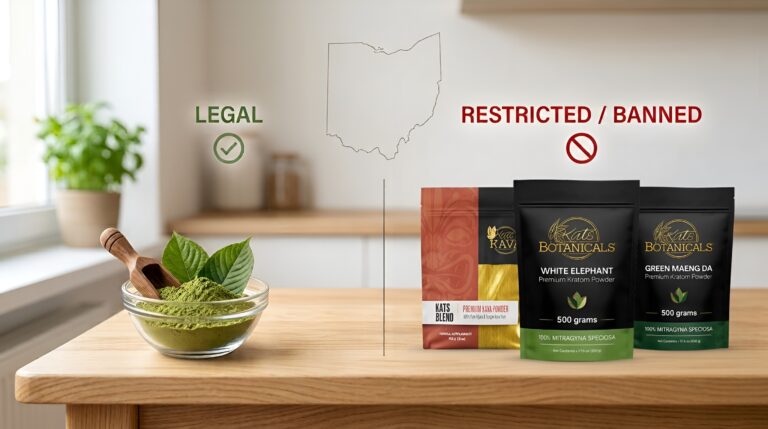
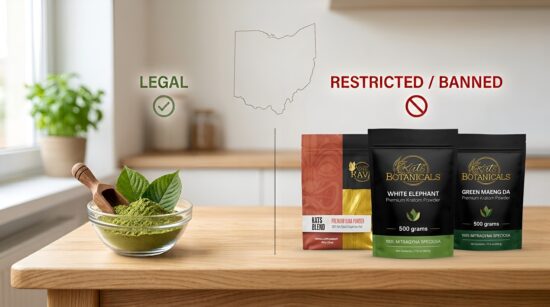
Ohio didn’t outlaw kratom. The state drew a line through the category and put each half on a different side. On one side sits the plant in its plainest form, dried leaf and ground powder, which stays legal. On the other sits anything processed, concentrated, or dressed up as a consumer product, which does not.
Working out which side a product lands on is the whole game here, because the same leaf can be legal as a bag of powder and banned as a flavored gummy.
Natural Leaf and Powder Kratom Stays Legal
The leaf itself, and plain powder milled from it, remains legal to buy, own, and use in Ohio. This is the form kratom has taken for generations in Southeast Asia: dried Mitragyna speciosa leaf, ground down, with nothing added and nothing stripped out. Capsules filled with that same plain powder fall under the legal form too, since a capsule is a container, not a chemical change.
What keeps this category legal is how close it stays to the plant. Nothing gets isolated, nothing gets boosted, and it isn’t sold with the kind of claims that turn a leaf into a food or a drug in the eyes of the state.
Processed, Synthetic, and Concentrated 7-OH Products are Banned
Ohio’s restriction targets kratom that’s been changed or marketed into a different kind of product. That covers synthetic kratom alkaloids, products concentrated to raise their 7-hydroxymitragynine (7-OH) content, and kratom sold as a food, drug, gummy, drink, or dietary supplement. 7-OH is a minor alkaloid present only in trace amounts in natural leaf, so concentrating it is exactly the kind of processing the rule singles out.
Transformation is the thread running through all of it. A gas-station shot marketed as an energy supplement, a gummy infused with concentrated extract, a drink pitched as a wellness beverage: each one has been pushed away from plain leaf and toward a manufactured product, and that push is what lands it in the banned column.

How Ohio Got Here: The Rule, The Order, and The Ruling
Three separate actions stacked up over roughly a year to produce today’s split, and no single news story walked readers through all three. Taken together, a Board of Pharmacy notice, a governor’s order, and a court ruling now agree with one another, which is why the picture is steadier than it looks from the outside.
The Board of Pharmacy’s Scheduling Attempt and DeWine’s Executive Order
The Ohio Board of Pharmacy opened the sequence by moving to schedule kratom’s alkaloids, mitragynine and 7-hydroxymitragynine, as controlled substances through a notice of intent. That’s not a hypothetical: the government’s own push over the past decade sought to classify naturally occurring mitragynine and 7-OH as Schedule I substances, a move CNN’s reporting notes would have reached the compounds as they occur in the plant itself, not just in processed extracts. A straight scheduling of those two compounds would have swept up all kratom, leaf included, because the plant naturally contains both.
Governor Mike DeWine’s executive order narrowed that reach. Rather than banning the plant outright, the order set the distinction that now defines the market: NBC4 reported that DeWine made clear the order applied only to synthetic kratom, leaving natural leaf to a separate rulemaking track. The Ohio Attorney General’s field guide for law enforcement reflects the same split, giving officers a way to tell a legal bag of powder from a banned manufactured product.
The Franklin County Court Ruling That Kept the Ban in Place
Kratom sellers challenged the restriction in court, and on August 7, 2026, a Franklin County Court of Common Pleas judge sided with the state, denying an industry request to freeze the rule and leaving the ban on processed and synthetic kratom in place while the case heads to trial. In the judge’s own reasoning, the Board of Pharmacy’s rule, however costly to sellers, appears aimed at preventing the ill effects that may arise from abuse of kratom products. For shoppers, the practical upshot is that the natural-leaf-legal, processed-banned framework isn’t a temporary notice waiting to be struck down. It has survived a court test.
That distinction matters. A rule that has cleared a courtroom is far more settled than one still working its way through agency notices or pending bills. For most of 2025, the live Ohio story was proposed legislation, and that framing is now out of date. The current situation is set by a rule, an order, and a ruling that already line up.
How To Tell If a Kratom Product is Legal To Buy in Ohio
Start with two questions: what form is the product in, and how is it sold. Natural leaf and plain powder in a simple bag or capsule sits on the legal side. A product that’s been concentrated, synthesized, or packaged as a gummy, drink, shot, or labeled supplement sits on the restricted side. Most products answer both questions at a glance.
Check the Form, Not Just the Name
The physical form tells you most of what you need. Loose powder, crushed leaf, and capsules of plain powder are the legal form. Gummies, infused drinks, liquid shots, and concentrated extracts are the forms the restriction reaches. A brand name or a strain name on the front of the bag doesn’t shift the category; the form inside does.
So if a product has been turned into something you’d expect to find on a candy shelf or in an energy-drink cooler, treat it as the processed form no matter what it’s called.
Read the Label for Supplement Claims and Concentrated 7-OH
Labels carry the other half of the answer. Watch for a “Supplement Facts” panel, dietary-supplement language, or any wording that markets the product as a food or a drug, since that framing is part of what the restriction covers. Then check for concentration: words like “enhanced,” “extract,” or “fortified,” or a stated 7-OH percentage, all point toward the concentrated category Ohio restricts.
An unlabeled product with no clear ingredient information is its own warning sign. If a capsule from a gas station tells you nothing about what’s inside or how concentrated it is, you can’t confirm it’s plain leaf, and the safe read is to leave it on the shelf.
What To Do If You Buy or Possess Kratom in Ohio
For plain leaf and powder, buying and keeping kratom in Ohio works much as it did before any of this. For anything processed or ambiguous, caution is the smart default, because the cost of guessing wrong falls on you, not the seller.
Buying and Possessing Natural Leaf Kratom Today
Buying and possessing natural leaf kratom is legal in Ohio right now, so a bag of plain powder or a bottle of plain-powder capsules sits on firm ground. The reliable way to stay on the legal side is to buy from sellers who are transparent about what they’re selling: plain leaf powder,third-party lab tested, with acertificate of analysis that shows what’s in it and what isn’t.
That transparency pulls double duty. A lab report confirms the product is plain leaf rather than a concentrated extract, which happens to be the exact line Ohio’s rule turns on.
Holding a product you’re unsure about, say an unlabeled capsule or a gummy of unknown origin? The cautious path is not to assume it’s fine. Check the label, look for lab results, and if you can’t confirm it’s plain leaf, don’t treat it as legal by default.
Why the Rules Could Change Again, and How to Keep Track
Ohio’s kratom rules have already moved twice in a year, so treating any version as permanent would be a mistake. An executive order can be revised, an agency can issue a fresh notice, and a court ruling can be appealed. The framework is settled for now, not forever.
A couple of habits keep you current. Check the Ohio Board of Pharmacy’s own notices for the official rule instead of leaning on a news headline, and watch the American Kratom Association, which tracks state-level kratom developments. Kratom’s legal status also varies from one state to the next, so the Ohio picture says nothing about anywhere else; check the law wherever you actually live and shop.

Where Plain-Leaf Kratom Fits at Kats Botanicals
Kats Botanicals works on the natural-leaf side of this line. We sell kratom as plain leaf powder and as capsules of that same powder, sourced from Southeast Asia and tested by independent third-party labs, with a certificate of analysis available for each batch. That testing tells you what’s in the bag and confirms it’s plain leaf rather than a concentrated or synthetic product, which is the precise detail Ohio’s rule depends on. Individual responses to kratom vary, and nothing here is medical advice; the straightforward takeaway is that transparent, lab-tested plain-leaf products are the simplest way to stay on the legal side in Ohio.