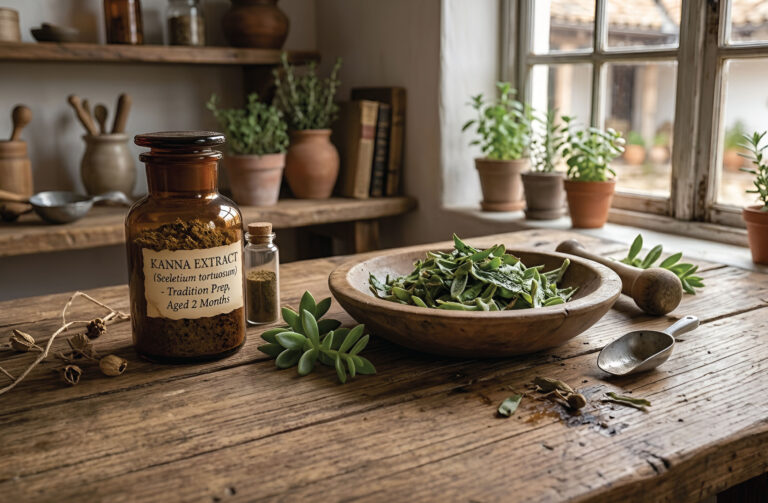
Kanna is a small succulent plant native to South Africa, known botanically as Sceletium tortuosum. For centuries, the San and Khoikhoi peoples of the Cape region chewed and fermented the plant as part of daily life and social gatherings. Today it turns up in the wellness world as a powder, a concentrated extract, and capsules, valued for a calm, settled, and sociable kind of mood lift. It sits in the same broad family of plant botanicals as kratom and kava, though it works through different pathways and feels different in the body.
Quick Answer: Kanna (Sceletium tortuosum) is a succulent from South Africa traditionally fermented and chewed for a calm, uplifted, and sociable feeling. Its plant compounds, chiefly mesembrine and mesembrenone, interact with serotonin pathways in the brain. Most people take it in powder, capsule, or extract form as a gentle daytime botanical rather than a sedative.
What is Kanna, Exactly?
Kanna is the common name for Sceletium tortuosum, a low-growing succulent in the Aizoaceae family that grows in the dry, rocky Cape regions of South Africa. Indigenous communities there have used it for more than 300 years, well before it had a scientific name. The plant is sometimes called “kougoed,” an Afrikaans word that roughly translates to “something to chew.”
Where Kanna Comes From
The traditional preparation is more involved than picking a leaf. Harvesters crush the plant, seal it in a container, and let it ferment for several days. That fermentation isn’t just for flavor. It shifts the balance of the plant’s compounds, which is why fermented kanna and raw kanna don’t behave the same way. This is worth understanding before you buy anything: the processing method matters as much as the plant itself, and a product that skips fermentation is a different thing from what the San people actually used.
The Compounds Behind Kanna
The activity in kanna comes from a group of alkaloids, and the four that get named most often are mesembrine, mesembrenone, mesembrenol, and tortuosamine. Mesembrine is usually the one present in the highest concentration. Researchers have described it as a serotonin reuptake inhibitor, meaning it appears to influence how the brain manages serotonin. Mesembrenone has been characterized as acting on an enzyme called PDE4. These are mechanisms observed in pharmacology work, not promises about how you’ll feel.
Here’s the part the marketing tends to skip. Alkaloid content in kanna varies wildly depending on where the plant grew, when it was harvested, and how it was fermented. Two bags labeled “kanna powder” can be very different products. Standardized extracts like Zembrin, which is prepared to a set total alkaloid concentration of about 0.4%, exist specifically because raw plant material is so inconsistent. If you care about knowing what you’re taking, that inconsistency is the whole ballgame.
Does Kanna Get You High?
No, kanna doesn’t get you high in the way that word usually means. At the amounts people typically use, it isn’t intoxicating, hallucinogenic, or impairing. Users describe the feeling as a lightening of mood, a sense of calm, and an easier time being social. Think closer to the settled feeling after a good conversation than to anything psychoactive.
That said, kanna extracts are stronger than raw powder, and some people take much larger amounts than tradition ever called for. The plant has a long history of moderate, everyday use, not of being pushed to extremes. The honest framing is that kanna offers a subtle shift for most people, and the “does kanna work” question often comes down to expectations. If you’re expecting a dramatic event, you’ll probably be underwhelmed. If you’re looking for a gentle mood and calm ingredient, that’s the lane it fits.
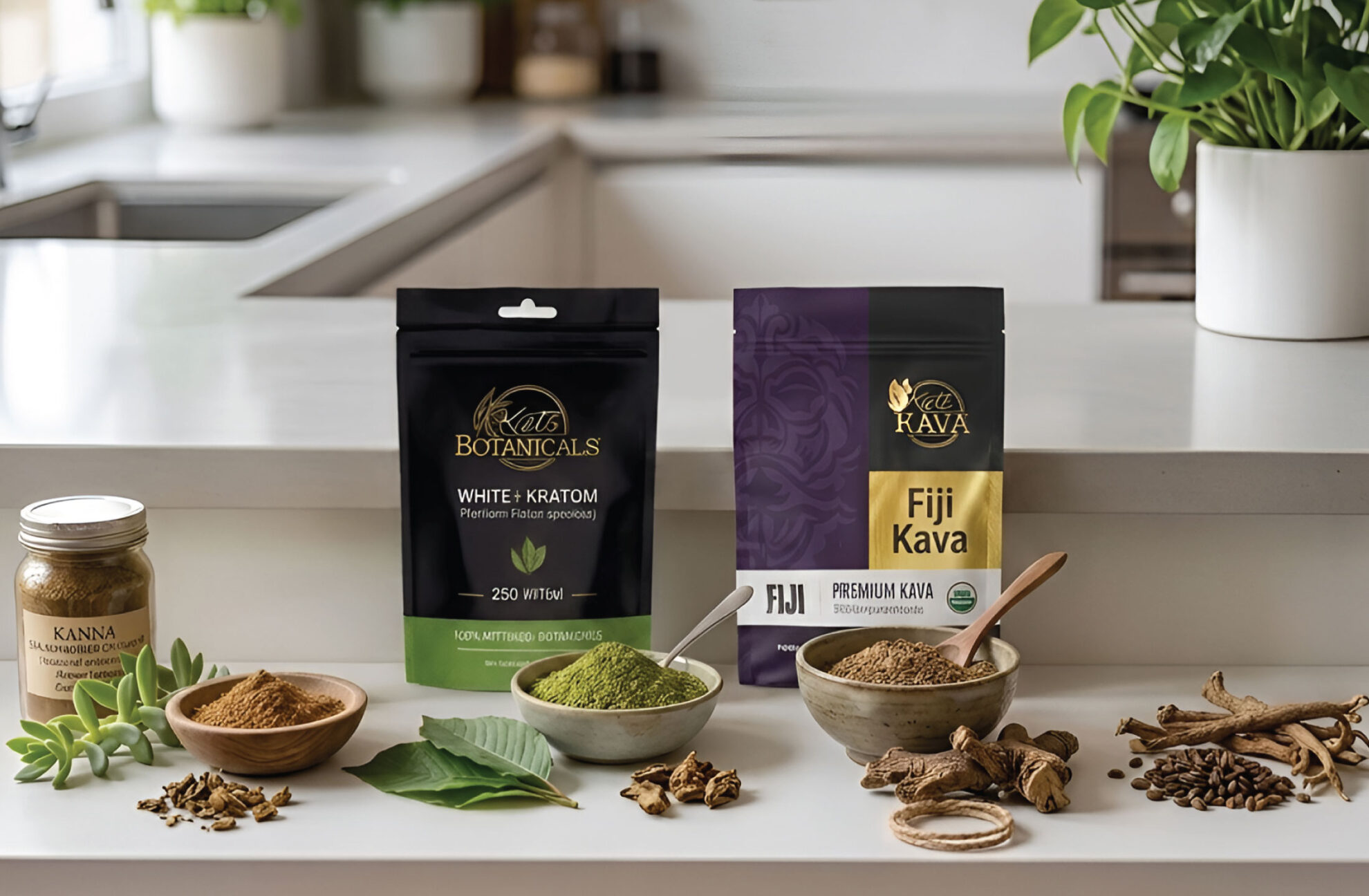
How Kanna Compares to Kratom, Kava, and CBD
People new to botanicals often want to know where kanna lands relative to products they already recognize. The short version: these plants come from different parts of the world, contain different active compounds, and are used for different reasons. Grouping them together makes sense as a category. Treating them as interchangeable does not.
| Botanical | Plant source | Origin | Main compounds | Commonly used for |
| Kanna | Sceletium tortuosum (succulent) | South Africa | Mesembrine, mesembrenone | Calm, mood, sociability |
| Kratom | Mitragyna speciosa (tree leaf) | Southeast Asia | Mitragynine, 7-hydroxymitragynine | Energy, focus, comfort |
| Kava | Piper methysticum (root) | Vanuatu, South Pacific | Kavalactones | Relaxation, evening wind-down |
| CBD | Cannabis sativa (hemp) | US-grown | Cannabidiol | Balance, everyday calm |
If you already use kava for winding down at night, kanna occupies a slightly different niche. It tends to feel more daytime-appropriate, since it isn’t primarily a sedative botanical the way kava root can be. Kratom is a different animal again, built around a separate set of alkaloids and a wider range of effects across strains. My take, having looked at how these get marketed: don’t switch from one to another expecting the same experience. They’re different tools for different moments. If you want a fuller side-by-side on the two most-compared options, the kava vs kratom breakdown walks through the same logic in more detail.
Types of Kanna Products and What to Look For
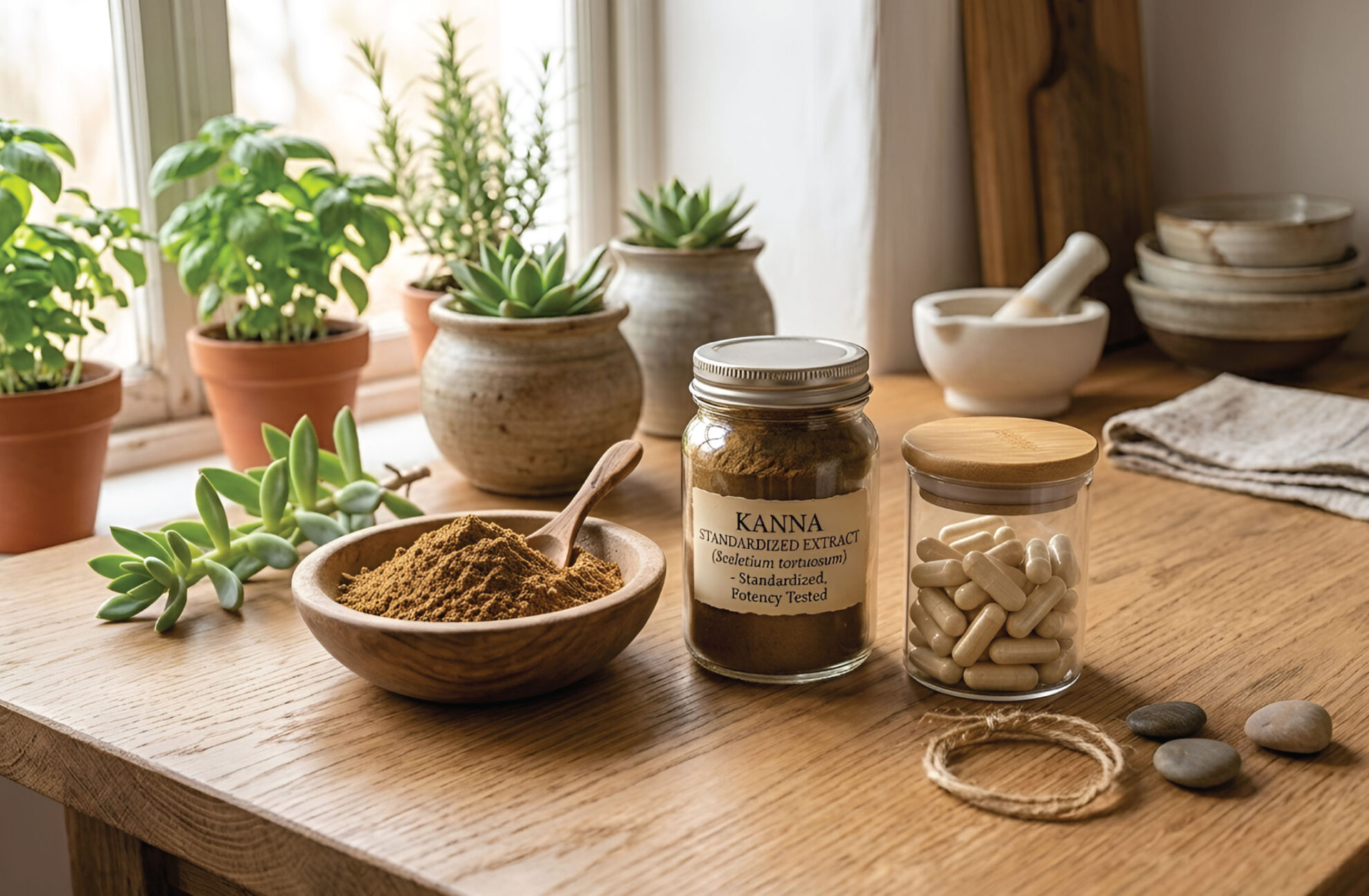
Kanna shows up in a handful of formats, and the right one depends on how much control you want over your amount and how much you care about consistency.
Kanna Powder
Raw or fermented dried plant material, ground fine. Powder is the closest thing to traditional use, and it gives you full control over how much you take. The trade-off is inconsistency: without lab data, you don’t know the alkaloid concentration, so the same scoop can vary batch to batch. Powder also carries a bitter, earthy taste that some people find hard to get past.
Kanna Extract
A kanna extract concentrates the plant’s alkaloids into a smaller volume, often standardized to a specific total alkaloid percentage. This is where standardization earns its keep. A reputable extract tells you what you’re getting, which raw powder rarely does. Extracts are stronger by design, so the “start low, go slow” principle applies here more than anywhere. If precision matters to you, a standardized extract is the format worth paying for.
Kanna Capsules
Capsules pre-measure the powder or extract into fixed amounts. They remove the guesswork and the taste in one move, which is why a lot of newcomers start here. The downside is less flexibility to fine-tune your amount. For anyone who values convenience and repeatability over control, capsules make sense.
What Separates Good Kanna From Filler
Whatever format you choose, a few things matter more than the label design. Look for third-party lab testing that confirms the alkaloid content and screens for contaminants like heavy metals and microbes. Look for a clear statement of whether the product is standardized, and to what percentage. Look for a brand that names its sourcing rather than hiding behind vague language. Where to buy kanna comes down to this: buy from sellers who publish their testing, not the ones who just promise “premium quality” without showing you a certificate of analysis.
Is Kanna Safe? Is It Addictive?
Kanna has a long record of traditional use, and at typical amounts most healthy adults tolerate it. That’s not the same as saying it’s risk-free for everyone. Because mesembrine appears to influence serotonin activity, anyone taking prescription medications, especially those that also affect serotonin, should talk to a healthcare provider before trying kanna. This is genuinely important, so it deserves emphasis.
Talk to your doctor first if you take any prescription medication, particularly antidepressants or other drugs that affect serotonin, before using kanna. Individual responses vary, and a provider who knows your history can weigh in better than any general article.
As for whether kanna is habit-forming, the traditional use pattern doesn’t point to the kind of compulsive use associated with habit-forming substances, and it isn’t classified as a controlled substance in the United States at the federal level. A three-month randomized, placebo-controlled trial in healthy adults using a standardized Sceletium extract reported it was well tolerated, though formal long-term safety research is still limited compared to more studied botanicals. The reasonable position is moderation: use the amount you need, take breaks, and pay attention to how your own body responds rather than chasing a stronger effect.