
If you buy or carry kratom in Michigan, the headlines from this past spring probably gave you a jolt. A ban bill cleared the state House. Within a single week you could find five versions of the story, none of them answering the one question that sent you searching: can you still walk into a shop and buy it today. The real picture is messier than any single news clip, because Michigan is not weighing one bill. It’s weighing two, and they point in opposite directions.
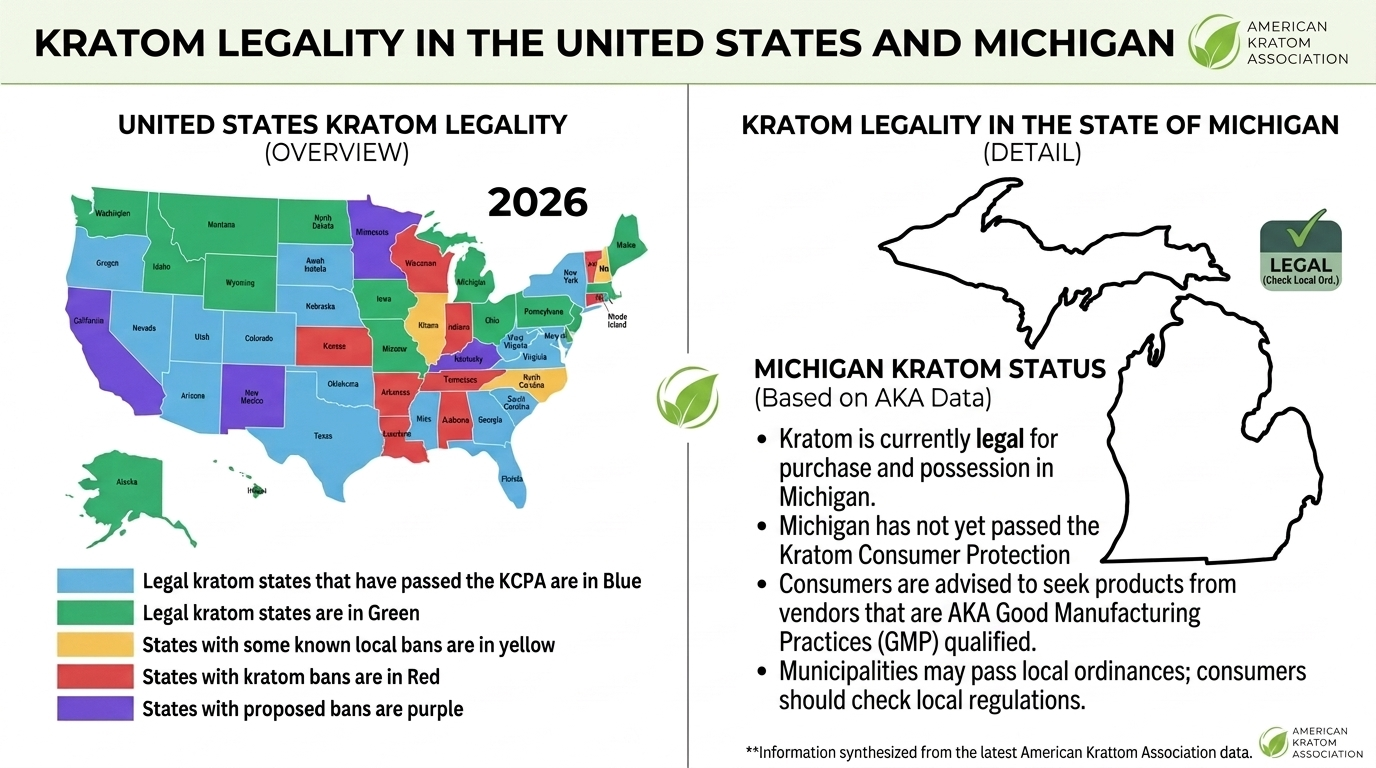
Quick Answer: Kratom remains legal to buy, possess, and sell in Michigan as of October 2026. The Michigan Legislature’s own bill-tracking record shows House Bill 5537 passed the House in March 2026 and was then referred to a Senate committee, with no Senate floor vote, no governor’s signature, and no enactment recorded since. House Bill 5537, which would ban it, cleared the Michigan House on March 18, 2026 by a 56-48 vote, according to the Michigan Legislature’s own bill-tracking record. From there, it still needs Senate passage and the governor’s signature before it becomes law, and neither has happened yet. Until that happens, nothing about your ability to purchase or carry kratom has changed, though it’s worth a quick status check before any large purchase.
What the “for Now” in That Answer Hinges On
It comes down to one bill, House Bill 5537, and the fact that it isn’t law yet. Nothing in it has taken effect, so every retail sale, online order, and personal stash in Michigan sits on the same legal footing it did a year ago. What changed in 2026 is not the law. It’s the odds that the law shifts, and that gap between “proposed” and “enacted” is the whole reason a flat yes feels incomplete. Because the legislature can act between the time this is written and the time you read it, the bill’s own record on the Michigan Legislature’s website is the only source current enough to trust.
The Push to Ban Kratom: Where the Bill Actually Stands
House Bill 5537 has passed one of the two chambers it needs and nothing more. The Michigan House of Representatives approved it in March 2026, which moved the measure forward but stopped well short of making it law.
How the House Vote in March 2026 Got the Bill This Far
A bill in Michigan starts in one chamber, gets debated and amended in committee, and then faces a floor vote. HB 5537 cleared that sequence in the House this past March. That vote is why the story hit the news, and it’s also why some readers walked away convinced kratom had already been banned. A House vote is a milestone, not a finish line.
What Still Has to Happen Before Any Ban Could Take Effect
For HB 5537 to become enforceable law, the Michigan Senate would need to pass it, any differences between the two chambers’ versions would need to be reconciled, and the governor would need to sign it. Each of those is a separate decision, and a bill can stall at any one of them. Until the Senate acts and the governor signs, there is no ban to comply with and nothing a shopper or seller has to do differently.
Why This Process Can Stretch on for Months
Legislation rarely moves on a schedule anyone can predict. Bills sit in committee, get crowded out by budget fights, or quietly die when a session ends without a vote. A measure that passes one chamber in the spring can wait until the following year for the other chamber to take it up, or never get taken up at all. None of that is unusual, and none of it signals whether the bill lives or dies; it only means the outcome is genuinely open.
Two Bills, Two Directions: Ban Vs. Regulate
Michigan isn’t just deciding whether to ban kratom. At the same time, a separate effort would regulate it, setting rules for how it’s labeled, tested, and sold rather than prohibiting it outright. These two approaches sit in direct tension, and reading that tension is the only way to understand what’s actually happening in Lansing.
What the Kratom Consumer Protection Act Would Do Instead of Banning It
The Kratom Consumer Protection Act, a model framework the American Kratom Association has promoted in state after state, keeps kratom legal while placing guardrails around it. That pattern isn’t unique to Michigan. The American Kratom Association’s own model legislation, the template behind most state Kratom Consumer Protection Acts, bars processors from selling kratom adulterated with dangerous non-kratom substances and from selling to anyone under 18 (or 21, depending on the state), while requiring clear labeling. The aim is a regulated market, not an empty shelf. Where it passes, a shopper gets lab-backed products and a seller gets clear rules to follow.
Why Lawmakers Are Pursuing Both Approaches at Once
Lawmakers disagree about what kratom is and what to do about it, which is how a legislature ends up weighing a ban and a safety framework in the same session. Some look at concentrated extract products on store shelves and reach for prohibition. Others see a plant that many adults use responsibly and prefer rules over a ban. Both camps can introduce bills, and both can advance, which is exactly the contradiction a Michigan shopper is living with right now.
What Each Outcome Would Mean for Someone Who Buys Kratom Regularly
If the ban becomes law, buying and possessing kratom in Michigan would eventually stop being legal, on a timeline the statute itself would set. If the regulatory act passes instead, kratom stays available, but shelf products would have to meet labeling and testing standards, and anything sold to minors or spiked with additives would be off the table. If neither passes this session, the status quo holds and the question reopens later. Three possible futures, and today you’re living in the one where nothing has changed yet.
Kratom and 7-OH Aren’t the Same Product, Legally or Otherwise
Most of the alarm driving the ban push is aimed at concentrated 7-OH products, not the traditional leaf. The two get lumped together in headlines, but they’re different things, and the difference matters for what’s actually in your cart.
What “7-OH” Means and Why It’s the Focus of the Ban Push
7-OH is shorthand for 7-hydroxymitragynine, one of the alkaloids naturally present in the kratom leaf, though only in trace amounts. The products that worry regulators are not the leaf. They’re concentrated or semi-synthetic items engineered to deliver far more 7-OH than any leaf contains, sold as shots, tablets, or gummies. That concentration is why these items draw regulatory attention that loose-leaf powder historically has not.
Whether Standard Leaf or Capsule Kratom Faces the Same Treatment
Traditional kratom, the ground leaf sold as powder, capsules, or tea, is a different product from a concentrated 7-OH shot, even though both trace back to Mitragyna speciosa. A broad ban like HB 5537 could sweep in every form, depending on how its final language defines kratom. A regulatory approach tends to go the other way, separating standard leaf products from concentrated ones and treating them differently. Which bucket your capsules or powder land in depends entirely on which bill, if any, becomes law.

What This Means for Buyers and Sellers in Michigan Today
Right now, today, you can legally buy and carry kratom in Michigan, and retailers can legally sell it. The pending legislation changes none of that until it becomes law, which hasn’t happened.
Can You Still Buy, Possess, or Carry Kratom in Michigan Now
Yes. No current Michigan law bars an adult from purchasing kratom online or in a store, keeping it at home, or carrying it, and that holds for powder, capsules, extracts, and other forms sold today. The one honest caveat is that “today” is doing real work in that sentence. A Senate vote months from now could redraw the picture, which is why a quick check beats an assumption.
What Retailers and Shop Owners Should Be Watching For
Shop owners carry the most exposure if the law shifts, so the Senate’s calendar is the thing to track. Should HB 5537 advance out of the Senate, a retailer would want to know the effective date and any sell-through provisions the final bill includes before anything takes effect. Watching the bill’s record directly beats relying on secondhand news, which tends to surface only at dramatic moments and go quiet in between.
How to Check the Most Current Status Before You Buy or Restock
The single most reliable source is the bill’s own page on the Michigan Legislature’s website, legislature.mi.gov, which logs every committee referral, vote, and amendment as it happens. The American Kratom Association also tracks state kratom legislation and advocates for the regulatory route over prohibition. Between those two, you can confirm in a couple of minutes whether anything has moved since this was written.
Where Kats Botanicals Fits While the Rules Are in Flux
While Michigan’s legislature sorts this out, the kratom you buy should be something you can actually verify. Kats Botanicals third-party lab tests every batch of kratom sold and publishes the results, so you know what’s in the powder or capsules before it reaches your door. The kratom lineup comes as powder, capsules, extracts, gummies, and teas, sourced from Southeast Asia, and every order is backed by a 30-day satisfaction guarantee. If a regulatory framework does pass in Michigan, lab-tested and accurately labeled products are exactly what it would require, which is the standard Kats Botanicals already holds itself to.