Last verified November 12, 2026.
Kratom is not illegal in Kentucky today. As of November 2026, adults 21 and older can legally buy it. That changes on July 1, 2027, when a new law bars processors and retailers from making or selling any kratom product. Concentrated 7-OH above 400 parts per million is already a Schedule I controlled substance.
We get this question more than most kratom companies, because Kats Botanicals has recently moved to Kentucky-based production, thanks to the recent changes in Tennessee kratom laws. We’re based in Franklin, a short drive north of the Tennessee line, and we’ve been supplying botanicals since 2016. When lawmakers decide to change the rules, they’re changing them in our home state too, and making it more difficult for us to provide our customers with the products they want.
This guide sticks to what the statutes and regulations actually say, with a link to each one, because the headlines haven’t kept up with the law. You’ll find what’s legal now, what changes in July 2027, where 7-OH fits, and how to shop carefully in the meantime.
Kentucky kratom law at a glance
Kentucky has passed two kratom laws in three years, and they reflect a progressively more restrictive attitude towards kratom and its complementary alkaloids. The 2024 law regulated kratom. The 2026 law ends all retail sales. Here’s the order it all happened in.
| Date | What changed | Where it lives |
| July 15, 2024 | House Bill 293 takes effect: 21+ age limit, a 2% cap on 7-OH, product standards, and civil penalties for sellers | KRS 217.2201 to 217.2207 |
| March 12, 2026 | 7-OH concentrated above 400 ppm (dry weight) becomes a Schedule I controlled substance | 902 KAR 55:015 |
| April 2026 | House Bill 757 becomes law, setting a statewide ban on kratom sales and processing | 2026 Ky. Acts ch. 161 |
| July 1, 2027 | The ban takes effect, and maximum penalties rise to $5,000 and $10,000 | KRS 217.2202 and 217.2207, new versions |
What Kentucky’s kratom law allows right now
Today’s rules come from House Bill 293, which took effect July 15, 2024. Under the current version of KRS 217.2202, a kratom processor or retailer can’t sell kratom extracts or kratom products to anyone under 21. The same statute sets product standards, including a cap that keeps 7-hydroxymitragynine (7-OH) at or below 2% of a product’s total alkaloid content. Alkaloids are the natural compounds in the kratom leaf, and 7-OH is one of them, normally present in small amounts.
Those rules put the responsibility on sellers. A processor or retailer that breaks them faces a civil penalty of up to $500 for a first offense and up to $1,000 after that, under the current KRS 217.2207. The statute doesn’t set out a penalty for adult buyers.
That’s the framework every Kentucky seller works under until July 2027, from corner stores to the kratom products in our own shop. It’s also why a seller that skips the age check is breaking state law today, not just cutting a corner.
Where 7-OH fits
Kentucky handles concentrated 7-OH very differently from kratom leaf. Since March 12, 2026, the state’s controlled substance schedule, 902 KAR 55:015, has listed “7-hydroxymitragynine (7-OH) concentrated at a level above 400 parts per million on a dry weight basis” as Schedule I. The same line says the designation “does not apply to mitragynine,” the alkaloid found in the largest amount in kratom leaf. Businesses had to pull 7-OH products above that level from their shelves, while kratom products and lower-7-OH products could stay.
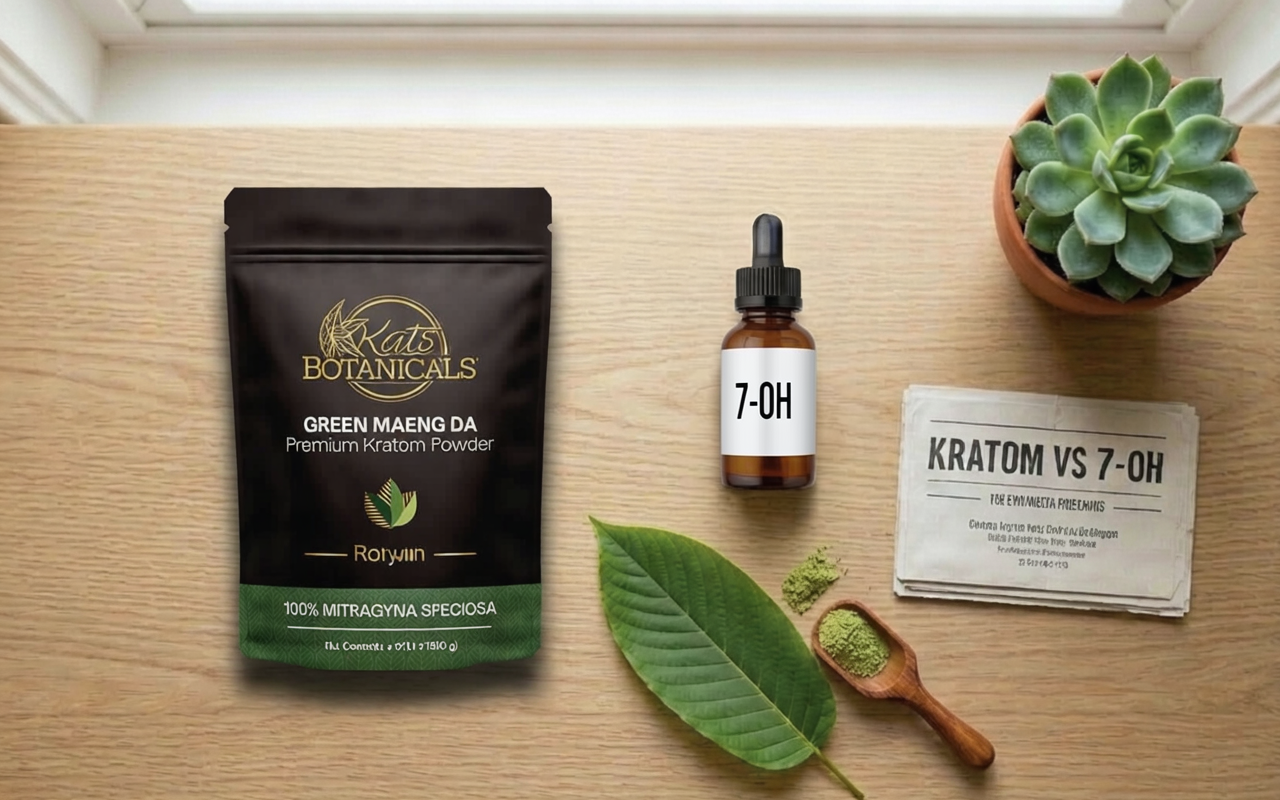
In plain terms, concentrated 7-OH now sits in the same legal category as other Schedule I drugs in Kentucky, and ordinary kratom leaf products made under the 2% rule do not. If you want the chemistry behind the difference, our guide to mitragynine vs 7-hydroxymitragynine walks through it.
What changes on July 1, 2027: the Kentucky kratom ban
House Bill 757, a 2026 revenue bill, rewrote KRS 217.2202. Starting July 1, 2027, the new version of KRS 217.2202 says a kratom processor or kratom retailer shall not “distribute, dispense, sell, or make available for sale any kratom, kratom extract, or kratom product,” and shall not prepare or manufacture one either. The age limit and the 7-OH cap drop out of the new text, because retail sales end entirely.
Penalties go up on the same day. Under the 2027 version of KRS 217.2207, a processor or retailer faces a civil penalty of up to $5,000 for a first violation and up to $10,000 for each one after that.
Who the ban covers
The definitions do most of the work here. Under KRS 217.2201, a kratom retailer is “any person or entity that sells or advertises, represents, or claims to sell kratom extracts or kratom products.” A kratom processor is anyone who prepares, manufactures, distributes or maintains them. A kratom product is anything meant to be eaten or swallowed that contains any part of the Mitragyna speciosa leaf or an extract of it, so powders, capsules, shots and gummies are all in scope.
What the statute doesn’t say
The new text is written for sellers. It doesn’t create an offense for an adult who buys or keeps kratom, and it doesn’t mention online orders shipped into Kentucky from another state. We’re not going to guess how regulators or courts will read those gaps. If your plans depend on the answer, talk to a Kentucky attorney before July 2027.
Is kratom illegal in Kentucky? Three mix-ups worth clearing up
Most of the confusion online comes from coverage that was accurate when it was written and then the law moved. These are the three we hear most often.
“Kentucky already banned kratom”
Not yet. When HB 757 passed in April 2026, a lot of coverage called it a ban, which is fair, but the ban doesn’t take effect until July 1, 2027. Until then, the 2024 rules apply and adults 21 and older can buy compliant kratom products.
“The ban starts January 1, 2027”
That was the original date. A later 2026 law, Acts chapter 198, moved it to July 1, 2027, according to the Legislative Research Commission’s note on the statute. Pages written in the spring still show January, so check the date on anything you read, including this page.
“Kratom and 7-OH are the same thing”
Legally, they’re not. Concentrated 7-OH above 400 ppm has been Schedule I since March 2026, while kratom leaf and mitragynine are covered by the sales rules in KRS 217.2202. Products marketed mainly on their 7-OH content are a different category from kratom powder or capsules, and Kentucky law handles them that way.
Federal law and the states around Kentucky
At the federal level, kratom leaf and mitragynine are not controlled substances as of November 12, 2026. The DEA did place three kratom-related compounds, mitragynine pseudoindoxyl, MGM-15 and MGM-16, in Schedule I with a temporary order effective August 26, 2026, and Kentucky’s schedule picks up federal temporary orders automatically. The DEA has also published notices that it intends to temporarily schedule 7-OH above a set threshold, and those were still notices, not a final order, when we last checked.
Tennessee, just south of us, banned kratom on July 1, 2026, and our Tennessee kratom laws guide covers what that means. If you live near the line, carrying kratom into Tennessee is a separate legal question from buying it in Kentucky.
Indiana bans kratom too, so two of Kentucky’s seven neighbors already prohibit it. Rules in the other states vary, and our page on kratom laws by state keeps a running list.
Recommended Read: Can You Fly with Kratom? Guide to Understanding If You Can Bring Kratom on a Plane
How to buy kratom legally in Kentucky before July 2027
Until the ban takes effect, buying kratom in Kentucky is legal if you’re 21 or older and the product meets the state’s rules. The practical question is how to tell if it does. A trustworthy product comes with a lab report, called a certificate of analysis (COA), that shows its alkaloid content, including 7-OH.
- Expect an age check. Selling to anyone under 21 breaks Kentucky law today, online or in a store.
- Find the COA for your batch. Match the lot number on the package to the lab report, then look for the mitragynine and 7-OH results.
- Do the 7-OH math. Kentucky’s current rule caps 7-OH at 2% of total alkaloids, so the 7-OH figure should be a small fraction of the mitragynine figure.
- Pass on concentrated 7-OH products. Above 400 ppm, they’re Schedule I in Kentucky, whatever the label calls them.
Think of a COA as the receipt for what’s actually in the bag. Every batch is third-party lab tested, and you can look up the certificates of analysis for any Kats batch by its lot number. If a vendor can’t show you the paperwork, the strain name on the bag is just a name.
The ban isn’t in effect yet: make your voice heard
Kats Botanicals is a Kentucky company, and here’s where we stand. We think the 2024 law was the right model: a 21+ age limit, a cap on 7-OH, product standards, and real penalties for sellers who cut corners. Kentucky had already moved separately against concentrated 7-OH in March 2026. A full ban takes the rules off the table along with the products, and we believe Kentucky adults deserve a regulated market instead.
The ban doesn’t take effect until July 1, 2027, and the General Assembly can change a law before its effective date. The 2027 regular session convenes January 5, 2027, and odd-year sessions are short, capped at 30 legislative days. That makes the next few months the window that counts.
- Find your legislators. Enter your address in the state’s Find Your Legislator tool to get your state senator and state representative.
- Call the Legislative Message Line at 1-800-372-7181. It’s toll-free, and you can leave a message for your senator and representative by name. Relay callers can dial 711, and a Spanish-language line (1-866-840-6574) runs during the session.
- Keep the message short and specific. Say where you live, that you’re an adult kratom consumer or a Kentucky worker in the industry, and that you support regulating kratom (age limits, lab testing, labeling and the 7-OH cap) instead of banning it. Ask them to amend or repeal the kratom provisions HB 757 added to KRS 217.2202.
- Follow up in writing. A short email or letter to each legislator repeats the same ask and gives them something to file. Stick to your own experience as a consumer and leave out health claims, which tend to distract from the regulation argument.
- Track the bills. The legislature’s Bill Status Line (1-866-840-2835) can tell you where any kratom bill stands once the session starts.
A call takes a couple of minutes. If you’ve bought kratom in Kentucky, legally and from a seller that showed you the lab results, your voice is exactly the one the 2024 law was written to protect. And be sure to check out the American Kratom Association state legality list for the latest news, trends, and updates.
Who should not use kratom, in Kentucky or anywhere
A change in legal status doesn’t change who should avoid kratom. Kentucky law limits sales to adults 21 and older, and kratom is not for use by pregnant or lactating women. Anyone taking medication or living with a medical condition, including heart disease, high blood pressure, or liver disorder, should consult a physician before using it. Kratom interacts with opioid receptors and may be habit-forming and lead to dependence, which is why that warning sits at the bottom of everything we publish.