Walk into a kava bar, order a bowl of something earthy and relaxing, and a reasonable question tends to follow: is this actually allowed? Kava’s reputation sometimes gets tangled up with substances that carry real legal weight, and a two-decade-old FDA advisory left behind a cloud of confusion that still hangs around. Before you buy a bag of powder or settle onto a bar stool, it helps to know exactly where this Pacific Island root stands with US law.
Quick Answer: Kava is legal in all 50 US states. It is sold as a dietary supplement regulated by the FDA, carries no DEA controlled-substance scheduling, and faces no state-level bans. Adults can legally buy, prepare, and drink kava, though some retailers and kava bars set their own minimum-age policies.
How Kava Is Regulated in the United States
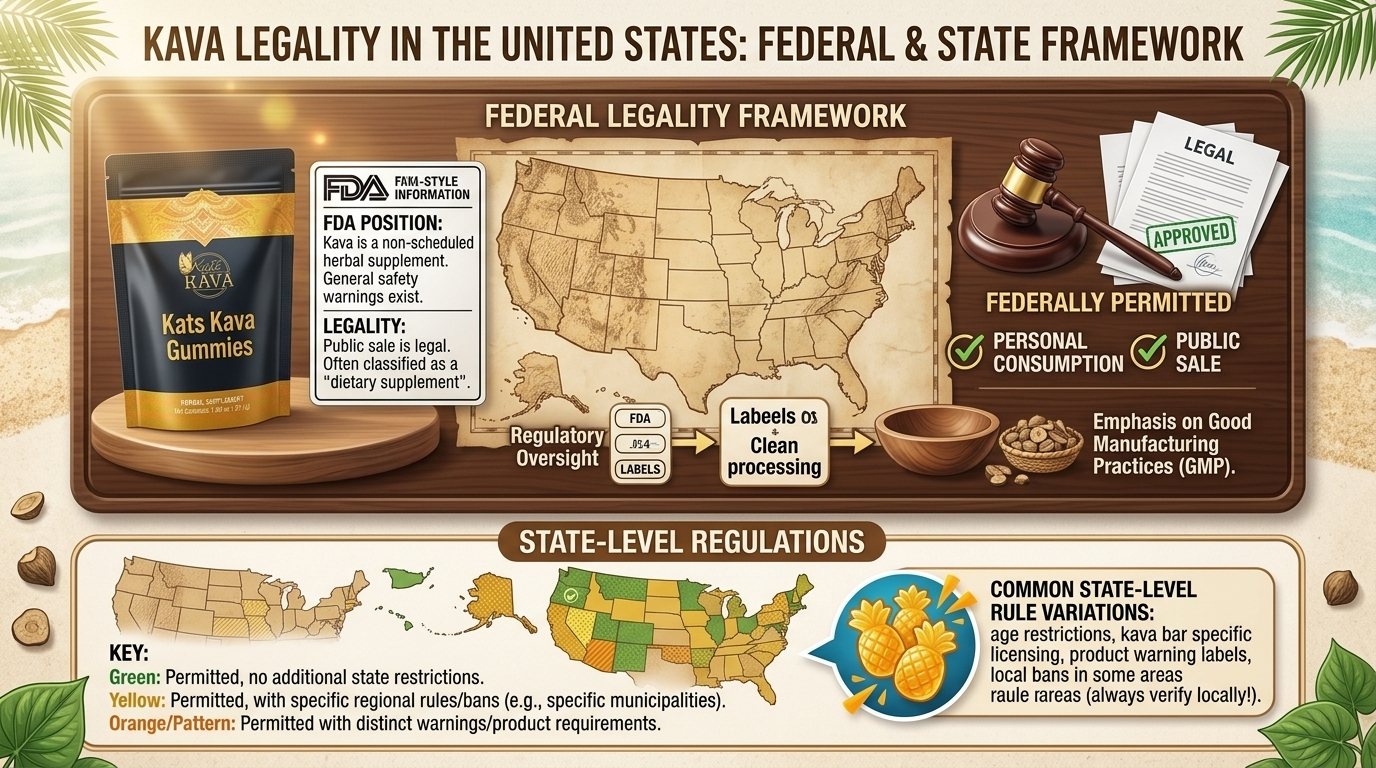
Kava sits in US law as a dietary supplement, and that single classification explains almost everything about its legal footing. The Dietary Supplement Health and Education Act of 1994, usually shortened to DSHEA, created the category that botanical products like kava fall into. Under that framework, the FDA oversees kava as a supplement rather than a drug, which means no prescription or pre-market approval is required, but the FDA’s own consumer guidance is clear that any disclaimer must state the product isn’t intended to diagnose, treat, cure, or prevent disease, since only a drug can legally make that claim.
Kava is Not a Controlled Substance
What kava is NOT matters just as much. That’s confirmed by the DEA’s own drug fact sheet, which lists kava’s control status plainly: not controlled under the Controlled Substances Act. No scheduling, no federal drug classification, which is the legal grounds on which kava bars, coffee houses, and online shops sell it openly across the country. That is the legal grounds on which kava bars, coffee houses, and online shops sell it openly across the country.
Confusion Linked to Advisory
The confusion usually traces back to one document. In 2002, the FDA issued a consumer advisory warning that kava-containing supplements had been linked to severe liver injury, citing more than 25 overseas adverse-event reports alongside a handful of US cases, one of them serious enough to require a liver transplant, as the NIH Office of Dietary Supplements notes in its summary of the advisory. A few countries restricted kava in response. The United States never did. Kava stayed on shelves, and later research softened the alarm: a 2007 World Health Organization review of kava found that the traditional water-based beverage carried a low level of risk when prepared in the customary way. The advisory was a caution, not a ban, and kava remains legal nationwide today.
Kava’s Legal Status in Every US State
Kava is legal in every US state, with no state having passed a law that bans it for adults. Unlike some other botanicals that face a shifting patchwork of state rules, kava’s status stays uniform from coast to coast, which is why a reader in Florida and a reader in Oregon get the same answer.
| State | Kava Legal? | State | Kava Legal? |
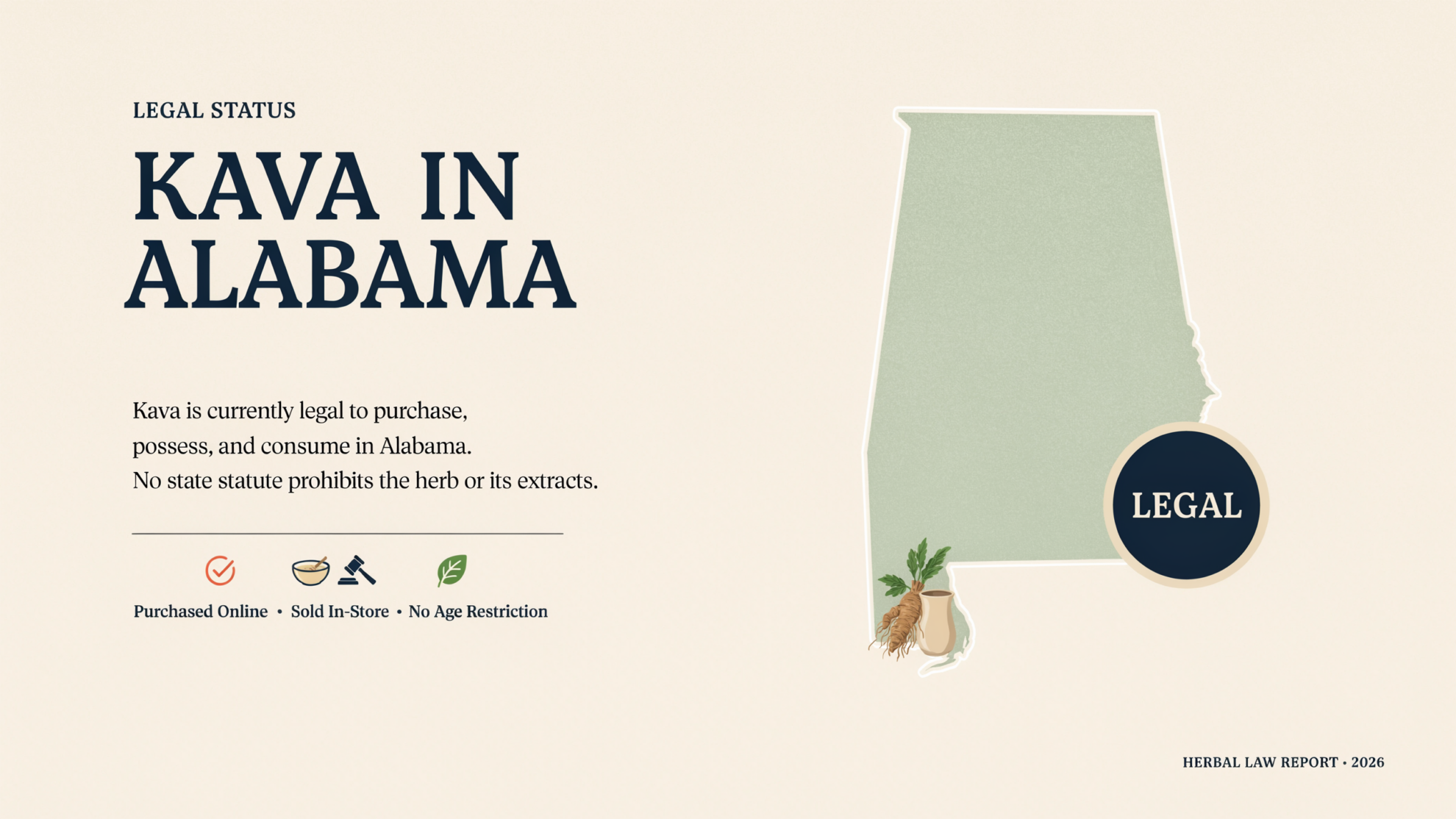
| Alabama | Yes | Montana | Yes |
| Alaska | Yes | Nebraska | Yes |
| Arizona | Yes | Nevada | Yes |
| Arkansas | Yes | New Hampshire | Yes |
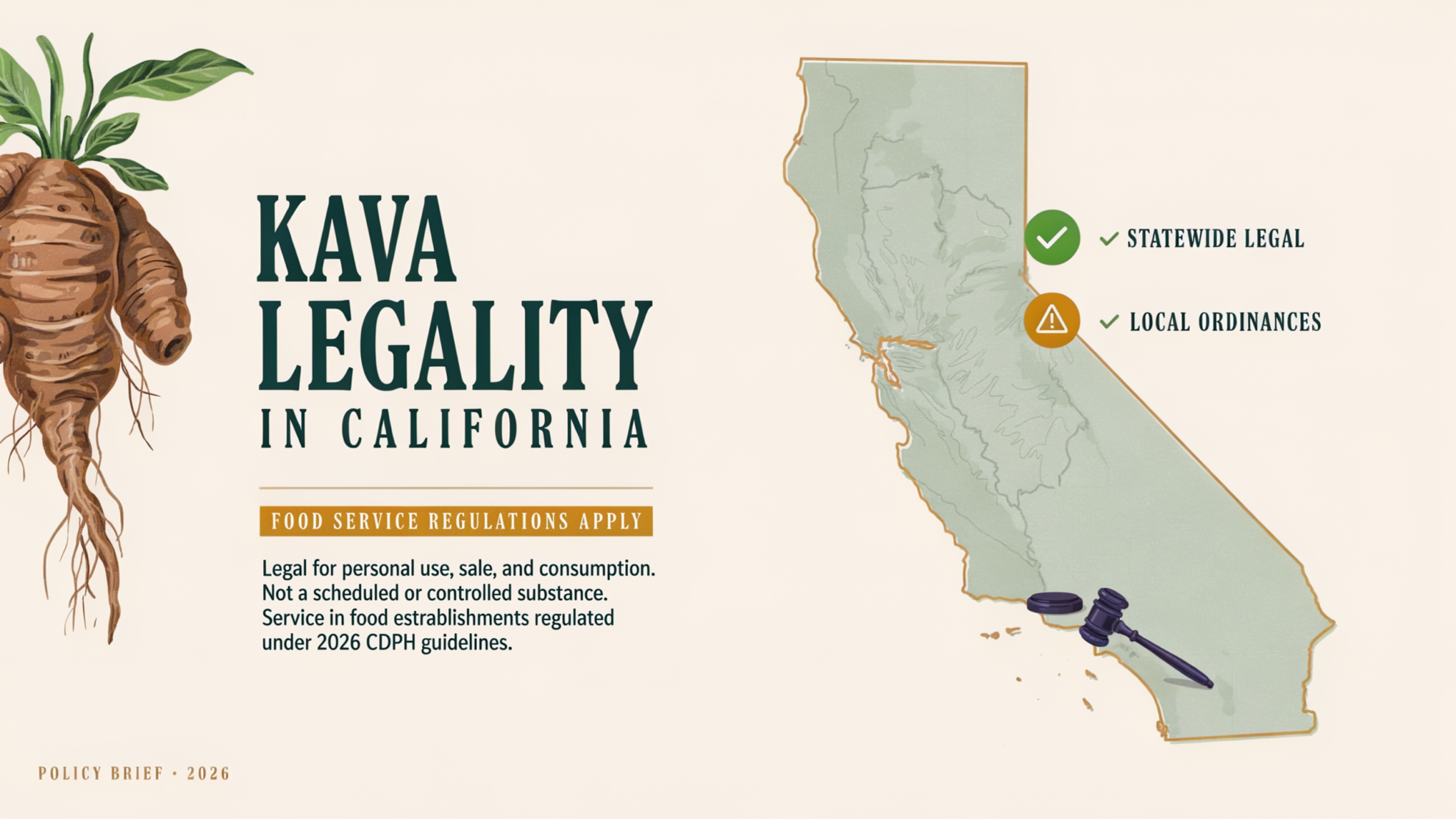
| California | Yes | New Jersey | Yes |
| Colorado | Yes | New Mexico | Yes |
| Connecticut | Yes | New York | Yes |
| Delaware | Yes | North Carolina | Yes |
| Florida | Yes | North Dakota | Yes |
| Georgia | Yes | Ohio | Yes |
| Hawaii | Yes | Oklahoma | Yes |
| Idaho | Yes | Oregon | Yes |
| Illinois | Yes | Pennsylvania | Yes |
| Indiana | Yes | Rhode Island | Yes |
| Iowa | Yes | South Carolina | Yes |
| Kansas | Yes | South Dakota | Yes |
| Kentucky | Yes | Tennessee | Yes |
| Louisiana | Yes | Texas | Yes |
| Maine | Yes | Utah | Yes |
| Maryland | Yes | Vermont | Yes |
| Massachusetts | Yes | Virginia | Yes |
| Michigan | Yes | Washington | Yes |
| Minnesota | Yes | West Virginia | Yes |
| Mississippi | Yes | Wisconsin | Yes |
| Missouri | Yes | Wyoming | Yes |
Kava is also legal in Washington, DC. Local ordinances and licensing rules can still shape how a kava bar operates in a given city, so the one caveat worth keeping is simple: the broad answer is uniform, but your own town may regulate businesses that serve it. When in doubt, check local rules.
Is There a Minimum Age to Buy or Drink Kava?
There is no federal law setting a minimum age to buy or drink kava. Because kava is regulated as a dietary supplement rather than as alcohol or tobacco, it does not come with a nationally mandated 21-and-over rule the way a six-pack does.
That does not mean age is a free-for-all. Many kava bars and online retailers set their own policies, and 18-plus or 21-plus is common. Some vendors require you to confirm you are at least 18 or 21 before checkout, partly as a matter of responsible business practice and partly to align with how relaxation products are generally sold. If you are shopping for the first time and wondering whether kava is legal under 21, the honest answer is that the plant itself is not age-restricted by federal law, but the shop you buy from very likely sets a cutoff of its own.
Driving, Impairment, and the Limits of “Legal”
Legal to buy does not mean consequence-free in every situation, and driving is the clearest example. Kava may promote a sense of calm and, in larger servings, can leave some people feeling drowsy. DUI laws in every state cover impairment from any substance, not just alcohol. An officer who determines that you are too impaired to drive safely can act on that regardless of whether the substance is legal or sold over the counter.
The practical takeaway is straightforward. If a kava drink leaves you feeling heavy-lidded or slowed down, treat it the way you would treat anything that affects how you feel behind the wheel, and wait until the effects pass before you get in the car. Individual responses vary, so pay attention to how your own body reacts before you plan a drive around a bowl of kava.
Choosing Noble Kava You Can Trust
Since kava is legal to buy nationwide, the real decision becomes which kava is worth your money. That comes down to the type of root and where it is sourced. Noble kava refers to the traditional, well-tolerated cultivars that Pacific Island communities have prepared for generations, as opposed to lower-grade material.
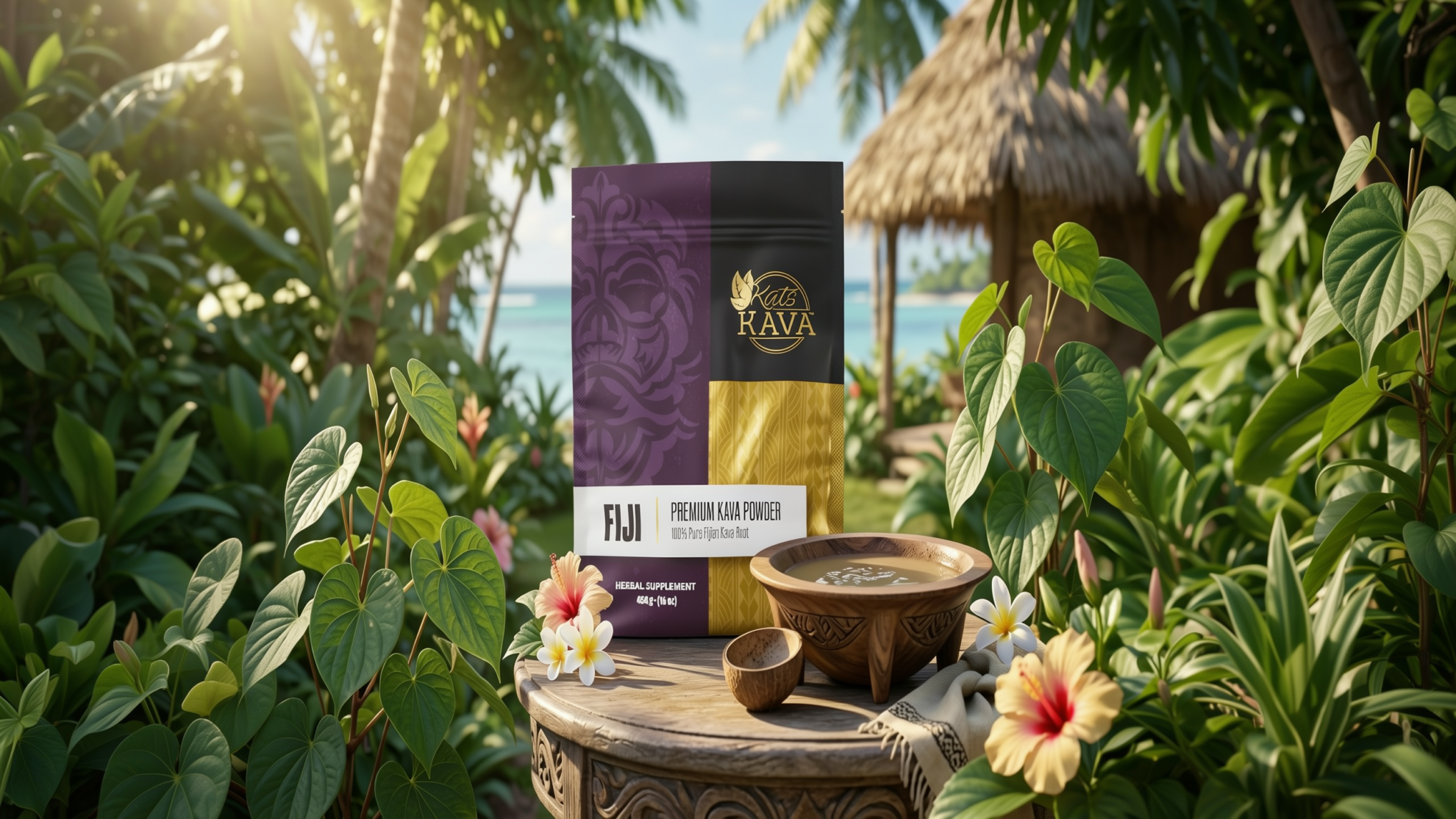
Kats Botanicals focuses on exactly that through its Buy Kava Powder Online – Premium Noble Kava Root & Extract collection, built around authentic Noble Kava sourced from the Pacific Islands. The lineup spans traditional powder, root extract, softgels, tinctures, gummies, and ready-to-drink options, with single-origin choices from Fiji, Vanuatu, and the Solomon Islands. For anyone who wants a transparent starting point rather than a mystery bag, Noble kava from a source that emphasizes third-party lab testing is a sensible place to begin an evening wind-down or a bit of social ease without alcohol.