Kratom is legal in Texas. Adults 21 and older can buy, sell, carry, and use whole-leaf kratom under state law, as long as the products meet the purity and labeling standards Texas put in place in 2023 and updated in 2025. If you’ve run across conflicting answers online, the confusion makes sense: the buying age changed, and recent federal news about a compound called 7-OH has muddied what people assume is now off-limits. Below is the current picture, why the rules shifted, and what a careful Texas shopper should check before spending a dollar.
Quick Answer: Kratom is legal for adults 21 and older in Texas. Senate Bill 497 (2023) set purity and labeling standards, capping 7-hydroxymitragynine at under 2% of a product’s alkaloid content, and Senate Bill 1868 from the 2025 session raised the minimum purchase age from 18 to 21. Recent federal action targets concentrated 7-OH products, not the whole-leaf kratom Texas adults can still legally buy.
Texas Kratom Law at a Glance
Kratom is legal statewide in Texas and is regulated as a consumer product, not a controlled substance. That single fact clears up most of the worry people bring to this question. You aren’t breaking any state law by keeping kratom powder in your pantry or ordering capsules to your door, provided you’re of age and the product is compliant.
Texas took what is often called a consumer-protection approach, the same framework behind the Kratom Consumer Protection Act model that several states have adopted. Rather than banning the plant, lawmakers chose to police how it’s made and sold. The result: the plant stays available to adults, and vendors face pressure to keep their products clean and honestly labeled.
What the Law Currently Requires
Texas law puts the compliance burden on sellers, and the standards are specific. A kratom product sold in the state can’t contain 7-hydroxymitragynine at more than 2% of its total alkaloid fraction, can’t be adulterated with any controlled substance under the Texas Controlled Substances Act, and can’t contain synthetic alkaloids. Labels must include serving-size guidance and accurate ingredient information. These aren’t suggestions. A product that fails them isn’t legal to sell in Texas, even though the kratom plant itself is perfectly legal.
That distinction matters more than it sounds. Legality here depends on the product’s makeup, not just the leaf. Two bags of powder can sit side by side on a shelf, and only one of them meets the state standard.
How Old Do You Have to Be to Buy Kratom in Texas
You must be 21 or older to buy kratom in Texas. This is the single point where nearly every ranking page gets it wrong, and the reason is simple: both numbers you keep seeing were once correct. The original law set the floor at 18. Senate Bill 1868 raised it to 21. So a 2023 article saying “18 and up” was accurate the day it was published and is stale now. If a page still tells you 18, it hasn’t been updated.
How Texas Kratom Law Has Changed From 2023 to 2026
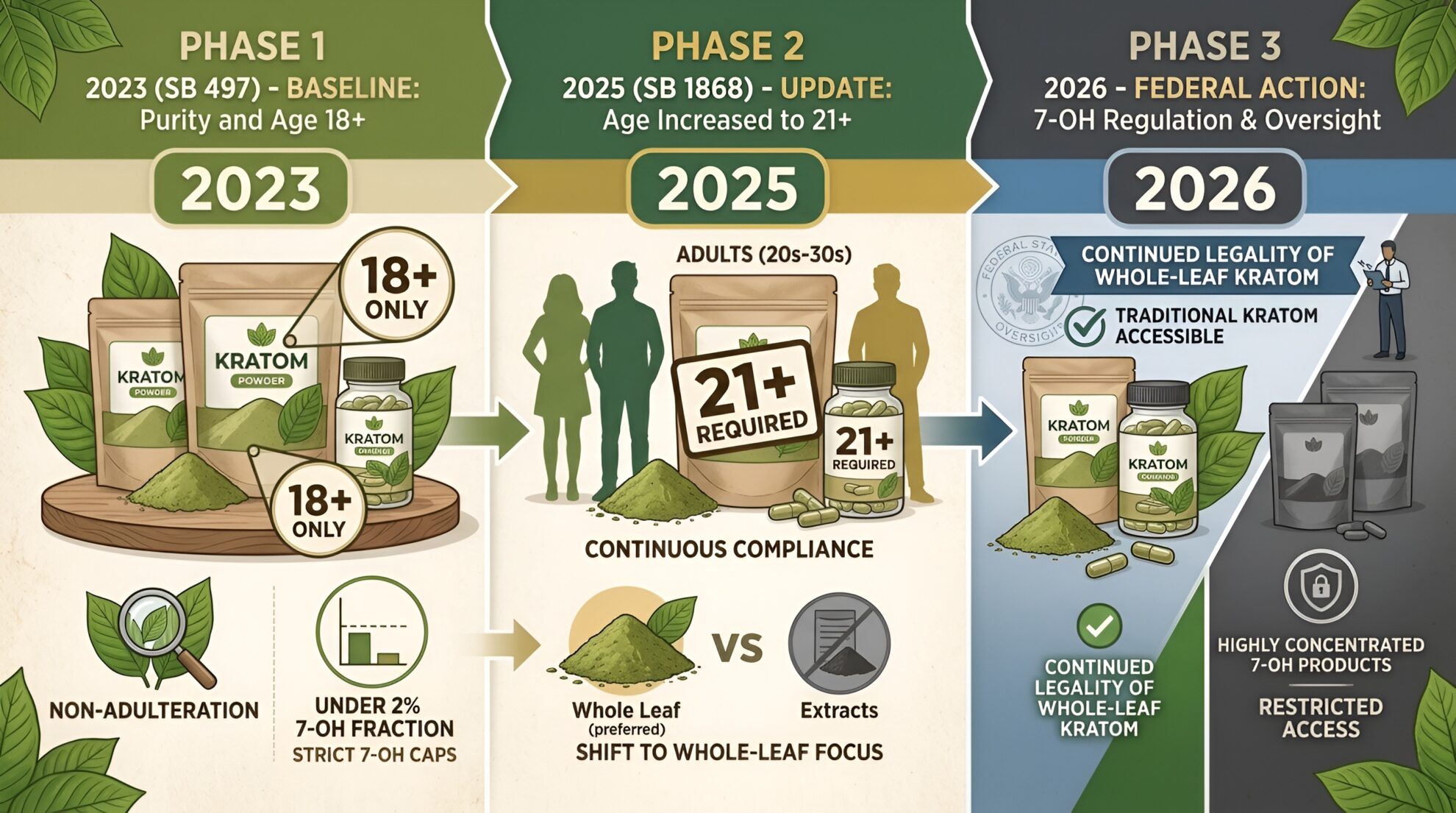
Texas kratom law moved in three stages: a 2023 baseline, a 2025 update, and a 2026 federal action aimed at one specific compound. Seeing them in order is the fastest way to understand why the age and headlines shifted, and why the plant stayed legal through it all.
Senate Bill 497: The Original Consumer Protection Baseline
Senate Bill 497 became Texas law on September 1, 2023, and it built the framework everything since has stood on. The bill held vendors responsible for purity and proper labeling, barred products adulterated with dangerous non-kratom substances, and set that 2% ceiling on 7-hydroxymitragynine relative to the total alkaloid content. The Texas Department of State Health Services published public guidance spelling out these standards.
The point of SB 497 was access with guardrails. It kept kratom on shelves while giving the state a clear line to enforce against bad actors selling tainted or mislabeled goods. Under this original version, sales were limited to buyers 18 and older.
Senate Bill 1868: What Changed Under the 89th Legislature
Senate Bill 1868, passed during the 89th Legislature in 2025, raised the minimum purchase age from 18 to 21 and tightened the state’s grip on the concentration side of the rules. It didn’t ban kratom or make ordinary whole-leaf products illegal. The headline change any shopper needs to remember is the age: 18 is the old number, 21 is the current one.
The reasoning tracks with how Texas treats other adult products, and it also reflects rising attention to highly concentrated kratom extracts rather than to traditional powder and capsules. If a wave of “is kratom still legal in Texas 2025” searches sent you here worried about a ban, this is the update behind that traffic, and the answer is that the plant stayed legal while the age went up.
Whole-Leaf Kratom vs. 7-OH: Why the Distinction Matters
Whole-leaf kratom and isolated 7-OH aren’t the same thing under the law, and conflating them is where most 2026 panic comes from. Whole-leaf kratom is the ground-up plant, the powder, capsules, and teas an adult can legally buy in Texas. 7-OH refers to 7-hydroxymitragynine concentrated or synthesized far beyond what the leaf naturally contains. Texas law and recent federal action both target the second one, not the first.
What 7-OH Is and Why It’s Being Singled Out
7-hydroxymitragynine is a minor alkaloid found in kratom leaves in trace amounts, usually a fraction of a percent. The compound regulators are worried about isn’t that trace amount. It’s products engineered to deliver 7-OH at concentrations the plant never produces on its own, sold as tablets or shots marketed for potency. Texas already addressed this in 2023 by capping 7-OH at under 2% of the alkaloid fraction, which is the state’s way of drawing a line between natural leaf and a concentrated derivative.
Think of it like the difference between a coffee bean and a caffeine pill. Same source, very different product, and it makes sense the law would treat them differently.
Does the DEA’s Move Change Anything for Texas Buyers Right Now
No. Federal action in 2026 against concentrated 7-OH products doesn’t make whole-leaf kratom illegal in Texas today. The distinction the DEA is drawing is the same one Texas drew in 2023: the concern is high-concentration 7-OH, not the traditional leaf. News coverage often blurs this, reporting a “kratom crackdown” when the target is a specific concentrated compound. A federal move against 7-OH and a Texas ban on kratom are two different events, and only the first is happening.
For a Texas adult buying compliant powder or capsules, nothing about the day-to-day changed. What did rise, according to reporting on poison-control data, is calls involving high-potency concentrates, which is exactly the category both the state cap and the federal action are aimed at. That’s another reason the whole-leaf-versus-concentrate line is worth understanding before you buy.
What This Means for Buying Kratom in Texas Today
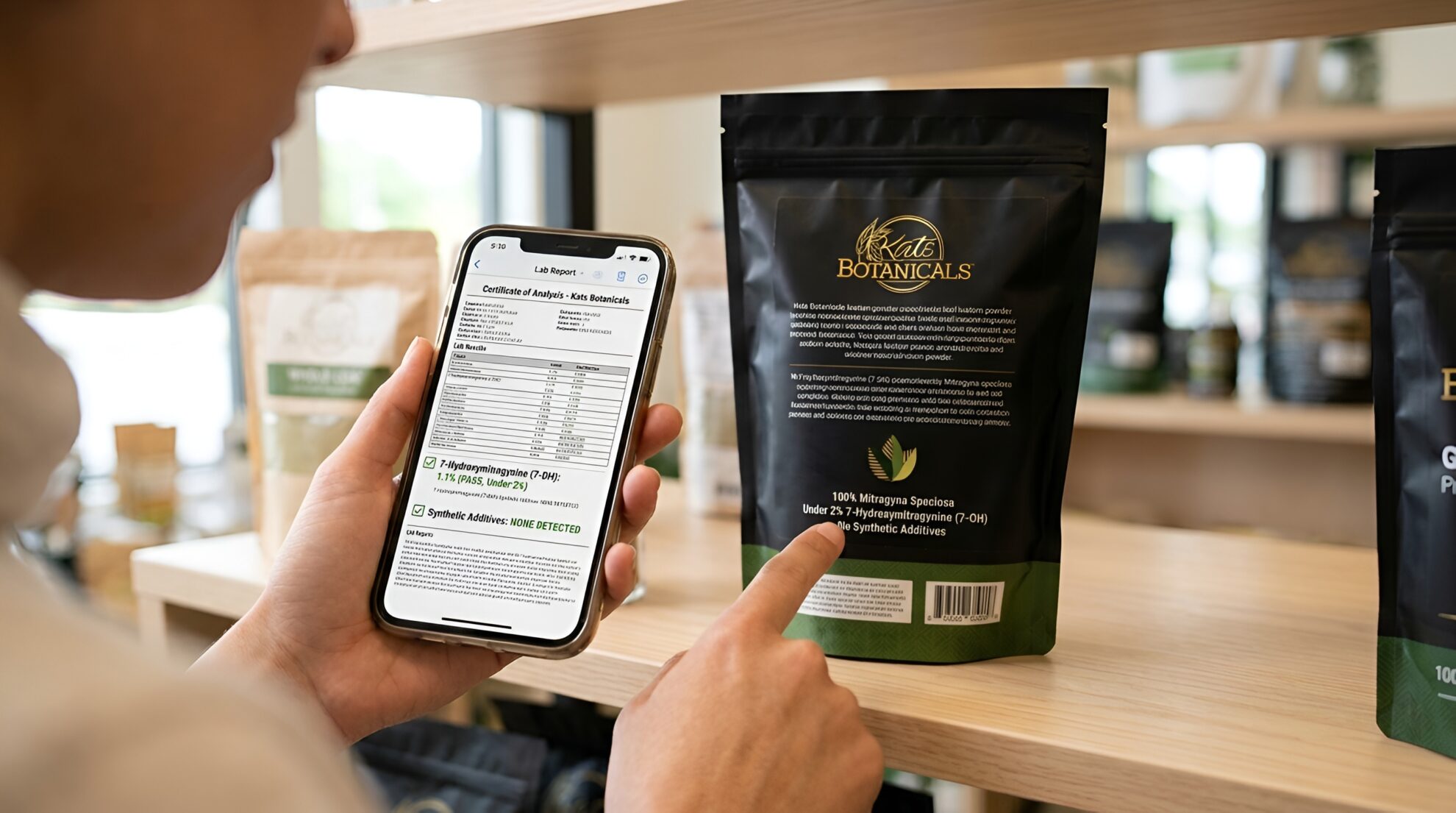
Buying kratom legally in Texas comes down to two habits: confirm the product meets the state’s purity rules, and confirm the vendor can prove it. The law is clear, but shelves and websites aren’t automatically compliant, so a few seconds of checking protects you.
What to Check Before You Buy
Before you buy, look for these on the product or the vendor’s site:
- A third-party lab report, sometimes called a Certificate of Analysis, confirming the alkaloid content
- 7-hydroxymitragynine listed at under 2% of total alkaloids
- A clear ingredient and serving-size label with no synthetic additives
- Language describing whole-leaf kratom rather than a concentrated 7-OH extract
If a product hides its lab results or leans hard on words like “extreme strength” without any numbers behind them, treat that as a reason to pass. Transparency is the whole point of the Texas framework, and a vendor unwilling to show its testing is telling you something.
Questions Worth Asking a Vendor
A quick conversation reveals a lot. Ask whether the vendor tests every batch through an independent lab, and ask to see the report for the exact product you want, not a generic one. Ask where the leaf is sourced and whether the company follows current good manufacturing practices. A vendor active with the American Kratom Association and its GMP standards program is signaling that it plays by the rules the AKA helped shape. If the answers are vague, or nobody can produce a current report, that hesitation is your answer. Walk away and buy from someone who can.
Buying Compliant Kratom From Kats Botanicals
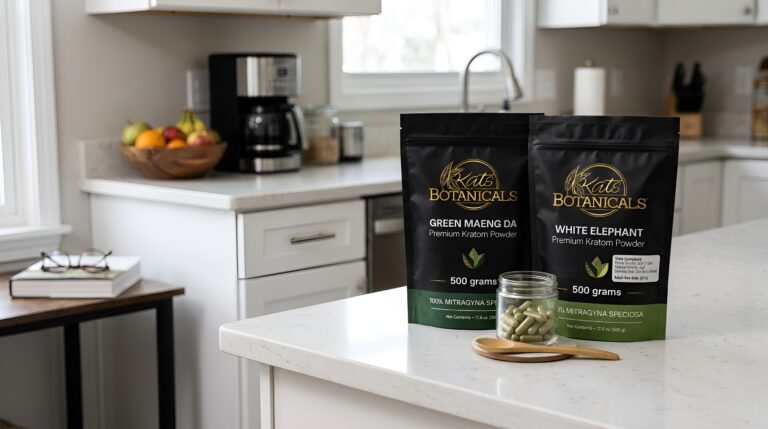
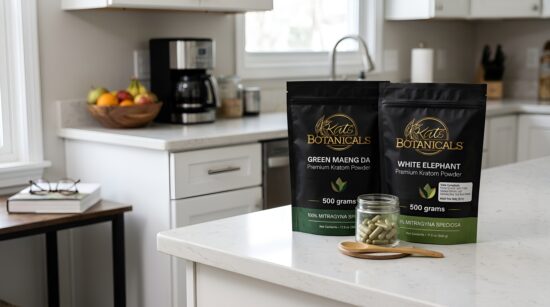
Kats Botanicals sells whole-leaf kratom that’s built to meet exactly the standards Texas requires. Every batch is third-party lab tested; Kats Botanicals works with a single-source farmer in Southeast Asia to keep the leaf clean, and its products follow the American Kratom Association’s guidelines. That means powders, capsules, and teas with published testing and honest labeling, and no synthetic alkaloids. For anyone in Texas trying to buy with confidence, the checklist above is the standard Kats Botanicals already holds itself to.