Kratom Legal Status in Wisconsin: 2026 Update
If you live in Wisconsin and you’ve gone looking for kratom, you’ve likely run into a dead end. National kratom retailers often skip Wisconsin at checkout, and most local shops either never stocked it or quietly pulled it from the shelf. That pattern isn’t a supply hiccup or a shipping quirk. It traces back to a specific choice Wisconsin lawmakers made about kratom’s chemistry.
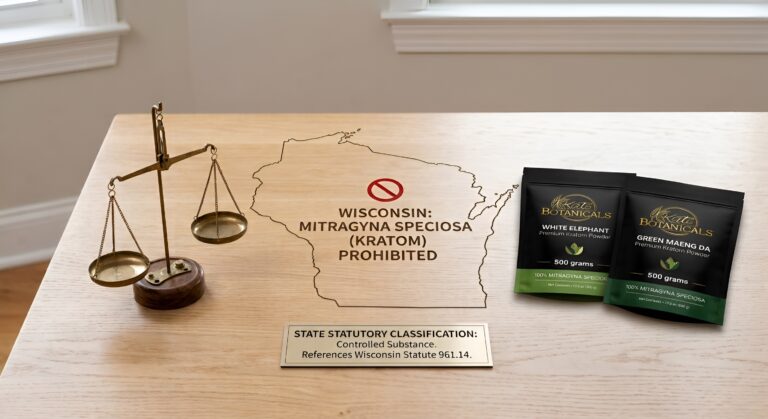
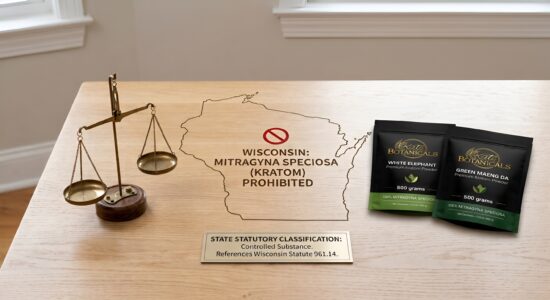
Quick Answer: Kratom is not legal in Wisconsin. The state classifies mitragynine and 7-hydroxymitragynine, the two primary alkaloids in the kratom leaf, as Schedule I controlled substances, which makes it illegal to sell or possess kratom products anywhere in the state. Federal regulators tracking state drug schedules confirm the designation: a 2026 Federal Register notice on 7-hydroxymitragynine names Wisconsin among the states that have already prohibited the compound. The American Kratom Association lists Wisconsin among the small number of states where kratom is banned.
How Wisconsin’s Drug Schedule Reaches the Kratom Leaf
Most state kratom bans don’t target the plant by name. They target what’s inside it. Wisconsin added mitragynine and 7-hydroxymitragynine, the compounds that give kratom its character, to its list of Schedule I controlled substances back in the mid-2010s, placing them in the same legal tier the state reserves for drugs it treats as having no accepted use. Because every kratom product carries those alkaloids by definition, scheduling the chemistry bans the plant without ever printing the word “kratom” in the statute.
That approach matters for one practical reason: there’s no loophole in the leaf. A red vein, a green vein, a powder, a capsule, an extract. They all contain mitragynine, so they all fall under the same prohibition. Switching strain or format changes nothing about the legal status.
The American Kratom Association, the trade group that tracks state-by-state status and lobbies for sensible regulation, has flagged Wisconsin as one of the six states that banned kratom between 2012 and 2017, and unlike most of the others, Wisconsin has never reversed course. Wisconsin’s ban also dates further back than most. It arrived in 2013 via SB 325, a model synthetic-drug bill that swept up mitragynine and 7-hydroxymitragynine along with hundreds of other compounds; legislative records show only five other states adopted that same model language. A 2023 bill to de-schedule kratom was introduced and went nowhere, so the original prohibition still stands.
What About 7-OH?
7-hydroxymitragynine, the alkaloid often shortened to 7-OH, is one of the two compounds Wisconsin named directly. A 7-OH product is not a workaround, then. It’s arguably more squarely illegal than raw leaf, since the statute calls that exact molecule out by name. If you’ve seen 7-OH shots or tablets marketed in other states and wondered whether they’re an option in Wisconsin, they aren’t.
What a Schedule I Listing Means for Buyers and Sellers
Schedule I is the strictest tier in Wisconsin’s controlled-substances framework, so possessing or selling kratom there is handled as a criminal matter rather than a regulatory slap on the wrist. The exact charge depends on the situation. How much is involved, whether the state alleges intent to distribute, and a person’s prior record all shape how a case is treated. Selling is taken more seriously than simple possession everywhere this kind of law exists, and Wisconsin is no exception: the University of Wisconsin System’s own legal-sanctions summary puts a first possession conviction at up to one year and $5,000, while manufacturing, delivering, or possessing with intent to deliver can draw up to 30 years and a $1,000,000 fine.
Because the specifics turn on circumstances and on statute language that gets amended, nobody should take a blog post as the final word on their own exposure. Anyone facing a real legal question about kratom in Wisconsin should read the current state statutes directly or speak with a Wisconsin attorney. The honest takeaway for a shopper is simpler: buying, carrying, or mailing kratom into Wisconsin is not a safe or legal thing to do while the alkaloids stay scheduled.
Wisconsin’s Wider Line on Cannabis, THC, and Vapes
Kratom’s status makes more sense once you see how cautious Wisconsin is with controlled substances in general. The state has not legalized recreational marijuana, and it remains one of the few states that has never created a medical cannabis program, so marijuana and marijuana-derived THC edibles sit outside the law there. Hemp-derived CBD containing less than 0.3% THC is a different story and is broadly available, the way it is federally.
The messier questions involve hemp-derived THC. Products like delta-8 and THCA occupy an unsettled, actively contested area that shifts with how state agencies and courts read the hemp rules at any given moment. Vapes are a separate category again: nicotine vaping products are sold legally in Wisconsin but carry state taxes and age limits rather than an outright ban. Each of these has its own rulebook, and all of them change, so the only reliable move is to check the current Wisconsin law for the specific product you have in mind. The thread connecting them is a state that leans conservative, which is the same instinct that put kratom on Schedule I.
Whether Wisconsin’s Kratom Ban Could Lift
The clearest path to legal kratom in Wisconsin runs through the Kratom Consumer Protection Act, a model bill the American Kratom Association has pushed in statehouses across the country. Rather than banning the plant, a KCPA sets age limits, labeling standards, and purity-testing requirements, treating kratom like a regulated botanical instead of a controlled substance. Several states have replaced prohibition, or filled a legal vacuum, with a version of it.
Wisconsin has not adopted that framework, and no change is guaranteed. Reversing a Schedule I listing takes legislative action, and that tends to move slowly. For residents who want the status to change, following the American Kratom Association’s advocacy and contacting state representatives is the realistic lever. Until a bill actually passes and gets signed, the current answer holds: kratom stays prohibited.
Botanicals Wisconsin Residents Can Still Reach For
Kratom isn’t an option for Wisconsin shoppers right now, but it isn’t the only botanical in the picture. Kava, the traditional Pacific Island root used for relaxation and easygoing social evenings, is federally legal and sold as a dietary supplement. Hemp-derived CBD under the 0.3% THC line is widely available too, for everyday calm and balance. Kats Botanicals makes both, with third-party lab testing on every batch and the same 30-day satisfaction guarantee that backs the rest of the catalog.
None of that is a stand-in for kratom’s specific profile, and individual responses to any botanical differ. It’s simply the honest set of choices still open to someone in Wisconsin who wants a natural wellness option while the kratom rules stay where they are.