Mitragynine and 7-hydroxymitragynine are the two alkaloids most responsible for how kratom feels, and they sit at opposite ends of the leaf. Mitragynine is the main event, making up the majority of the alkaloid content in most kratom. 7-hydroxymitragynine (7-OH) is a trace alkaloid, present in tiny amounts, and it acts far more strongly at the same receptor sites even in those small quantities. That gap in abundance and strength explains the confusion people run into online and the wave of concentrated “7-OH” products now showing up on shelves.
Quick Answer: Mitragynine is the dominant kratom alkaloid, typically the largest share of a leaf’s total alkaloids, and it drives most of kratom’s traditional effects. 7-hydroxymitragynine is a trace alkaloid and an active metabolite of mitragynine that binds mu-opioid receptors much more strongly. Because natural leaf contains so little 7-OH, products advertising high 7-OH concentrations are almost always concentrated or semi-synthetic, not whole-leaf kratom.
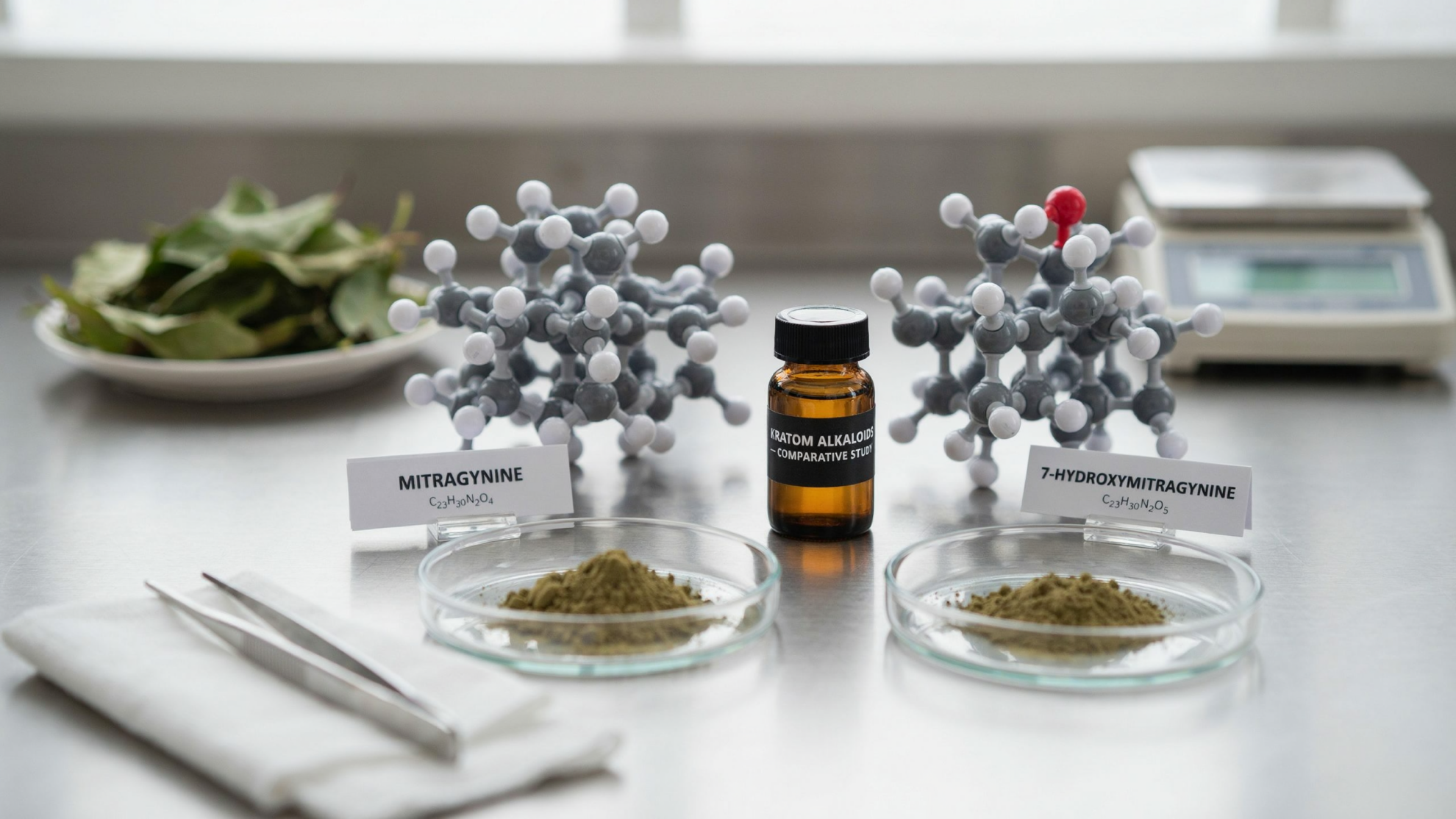
Mitragynine vs 7-Hydroxymitragynine at a Glance
Before getting into the chemistry, here’s how the two compare on the points people actually search for.
| Feature | Mitragynine (MIT) | 7-Hydroxymitragynine (7-OH) |
| Amount in leaf | Majority of total alkaloids | Trace, often under 0.05% of dried leaf |
| Role | Primary alkaloid | Active metabolite of mitragynine |
| Receptor activity | Lower affinity at mu-opioid receptors | Much higher affinity |
| Found naturally? | Yes, abundant | Yes, in small amounts; more forms in the body |
| In concentrated products | Sometimes enhanced | Often lab-concentrated or semi-synthetic |
The honest read here is simple. If a product leans hard on its 7-OH number as a selling point, that number didn’t come from the leaf on its own. That’s the part of this conversation worth slowing down for.
What Is Mitragynine?
Mitragynine is the most abundant alkaloid in Mitragyna speciosa and the one that shaped kratom’s traditional use. It was first isolated in 1921 by Ellen Field, a chemist at the University of Edinburgh, which puts kratom research ahead of the isolation of cannabinoids like CBD and THC by roughly two decades. People have been studying this molecule for a long time.
How Much Mitragynine Is in Kratom
Mitragynine dominates the alkaloid profile. In many samples, it accounts for well over half of total alkaloid content, though the exact share swings by region, harvest, and drying method. This is why mitragynine content, not 7-OH content, is the number that tells you the most about a whole-leaf product. When Kats Botanicals lists alkaloid concentrations on a product page and publishes third-party Certificates of Analysis, mitragynine is the anchor figure. It reflects the leaf as it actually grows.
How Mitragynine Behaves in the Body
Mitragynine interacts with mu-opioid receptors, but with lower affinity than 7-OH, and it also touches adrenergic and serotonergic pathways, which is part of why kratom’s effects shift with dose rather than pointing in a single direction. Lower amounts tend toward alertness and a lift in disposition. Higher amounts tend toward calm and evening wind-down. Users often describe a settled, sociable ease and comfort from everyday physical strain, and those reports line up with kratom’s long history among field workers in Southeast Asia. Individual responses vary, and a healthcare provider’s input matters more than any general description.
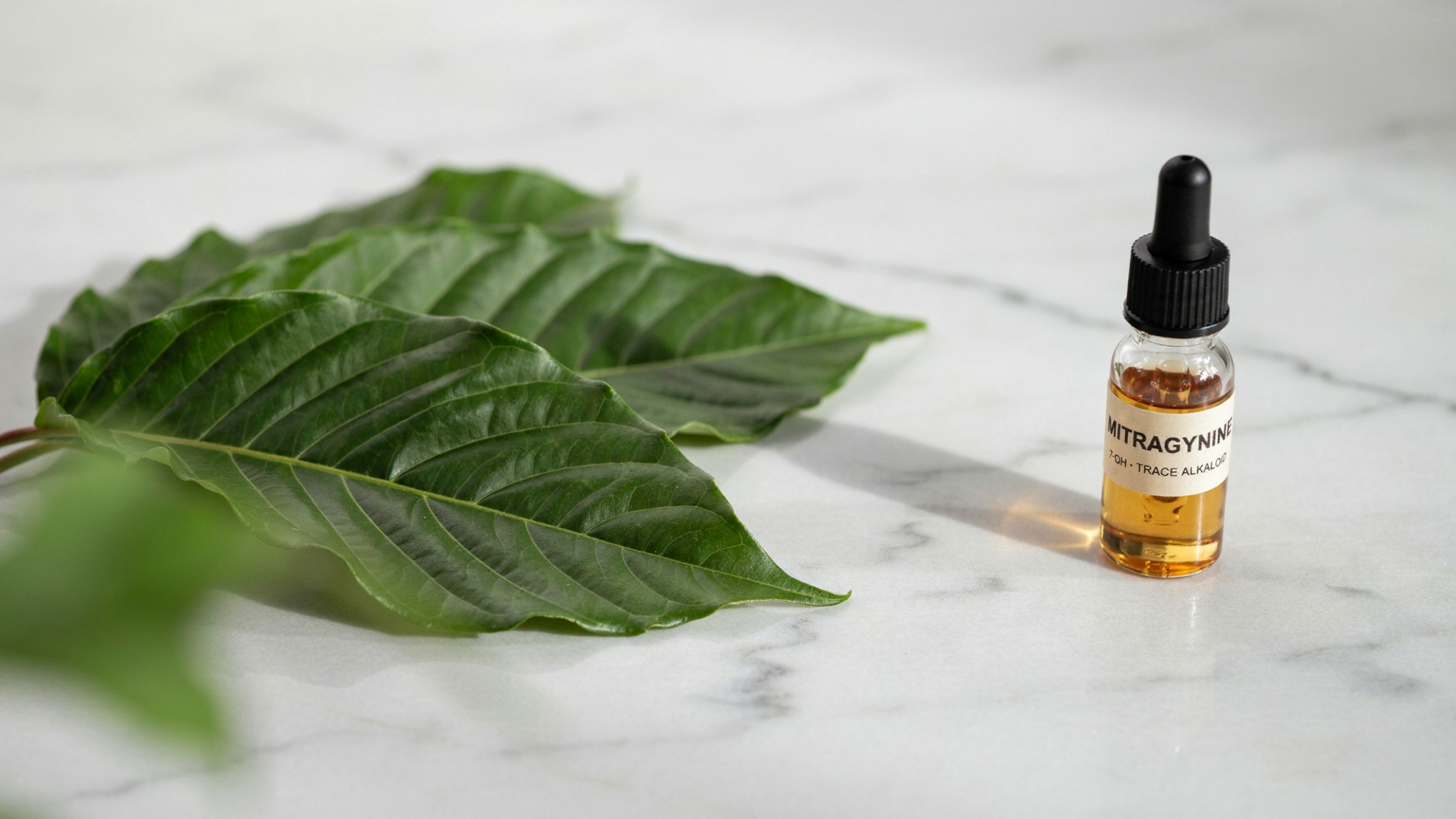
What Is 7-Hydroxymitragynine?
7-hydroxymitragynine is a trace alkaloid and an active metabolite of mitragynine. Two things are happening at once with 7-OH: a small amount exists in the raw leaf, and additional 7-OH forms inside your body as your liver metabolizes mitragynine. A 2019 paper in ACS Central Science by Kruegel and colleagues confirmed 7-OH as an active metabolite of mitragynine and a key mediator of its analgesic effects, meaning your system produces some of this metabolite naturally whenever you take regular kratom.
Why 7-OH Gets Compared to Morphine
The morphine comparison is where the “7-hydroxymitragynine vs morphine” searches come from, and it needs context. A 2016 study by Columbia University researchers published in the Journal of the American Chemical Society mapped how these alkaloids signal at the mu-opioid receptor and found 7-OH binds far more strongly than mitragynine. That’s a statement about receptor affinity in a lab, not a green light to take concentrated doses. The comparison describes molecular behavior. It doesn’t mean a 7-OH product is a safe or appropriate thing to concentrate and sell.
7-OH Is a Metabolite, Not a Standalone Ingredient
Here’s the part the marketing tends to skip. Because your body already makes 7-OH from mitragynine, whole-leaf kratom delivers this metabolite the way nature routed it: gradually, in small amounts, as a byproduct of digesting the primary alkaloid. There’s no gap to fill. A product engineered to be 7-OH-dominant isn’t giving you “more of what kratom does.” It’s giving you something the leaf never produces in that form or quantity.
The Rise of 7-OH Products, and Why We’re Skeptical
Concentrated 7-OH tablets, shots, and gummies marketed on “extreme strength” have spread fast, and Kats Botanicals doesn’t sell them. This isn’t a coy competitive jab. It’s a position on product logic. The strength claims that make these products stand out are the exact reason we think most people should walk past them.
Concentrated Is Not the Same as Natural
Do the arithmetic. If natural leaf holds only a trace of 7-OH, isolating enough to build a product around it requires either heavy extraction from enormous volumes of material or synthetic help in a lab. When you see a product boasting a 7-OH figure many times higher than anything the plant produces, that’s a signal the alkaloid was manipulated, not harvested. The American Kratom Association has said as much, warning consumers away from concentrated and semi-synthetic 7-OH products and declining to certify them as kratom under its GMP program.
Where Regulators Stand
The regulatory picture shifted recently. In July 2025, the FDA publicly recommended that the DEA schedule 7-hydroxymitragynine as a controlled substance, while drawing a line between concentrated 7-OH products and natural leaf kratom. Whatever your view of scheduling, the takeaway for a shopper is that federal attention is aimed squarely at concentrated 7-OH, not at whole-leaf kratom. That distinction is the one to hold onto when a vendor tries to blur it.
Why Full-Spectrum Kratom Makes More Sense
Our take, plainly: full-spectrum, mitragynine-dominant kratom is the version worth your money for almost everyone. It carries the leaf’s whole alkaloid profile rather than one isolated compound cranked past natural levels.
The reasoning holds up on practical grounds. Full-spectrum kratom is the least altered form, so what you buy resembles what the plant made. Many longtime users describe a rounder, more balanced experience from whole-leaf material than from isolates, an interplay some researchers attribute to the leaf’s mix of alkaloids working together. And kratom’s dose-dependent behavior gives you a built-in dial. You can shift the experience by adjusting how much you take, no isolate required. If you want something stronger than plain powder, enhanced kratom and extracts exist for experienced users. Start low, go slow, and treat any concentrated product with respect.
Dosage and Mindful Use
There’s no universal mitragynine and 7-hydroxymitragynine dosage, because the two aren’t interchangeable and 7-OH isn’t something you should be dosing on its own. For whole-leaf kratom, the dose is measured by grams of powder and guided by mitragynine content, and new users are best served starting at the low end and giving it time. Our kratom dosage guide walks through the ranges most people work within. The reason concentrated 7-OH is risky is precisely its strength; a small amount does a lot, which narrows the margin for a comfortable experience.
Safety note: Kratom is for adults 21 and older. It isn’t for pregnant or nursing women, and it may be habit-forming. If you take medications or have a medical condition, talk with a physician before using kratom, and avoid combining it with alcohol or other substances.