
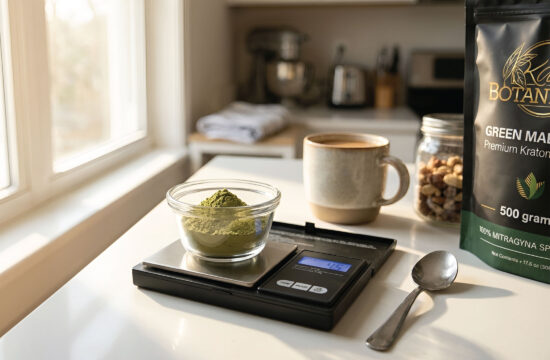
A high dose of kratom generally means anything above roughly 5 to 8 grams of powder taken at one time. That number isn’t fixed. Your body weight, how often you use kratom, your tolerance, and the specific strain all pull the line up or down. What feels like a lot to a first-time user might feel routine to someone who’s used kratom daily for two years. The honest answer is that “high” describes where you sit on a personal scale, not a single universal gram count that applies to everyone.
Kratom comes from the leaves of Mitragyna speciosa, a tree in Southeast Asia, and its effects come mostly from an alkaloid called mitragynine. Because the alkaloid content varies from batch to batch and person to person, dosing gets treated as a range rather than a prescription. Understanding those ranges, and why the high end deserves respect, is the whole point of this guide.
Quick Answer: A high dose of kratom is usually considered 5 to 8 grams or more of powder in a single serving, though tolerance and body weight shift that threshold for each person. Lower amounts, in the 1 to 3 gram range, are where most people report feeling something without pushing toward the heavy end. More kratom doesn’t reliably mean better results, and higher doses raise the odds of unwanted effects like nausea and grogginess.
What “Dose” Actually Means With Kratom
Dose refers to the amount of kratom powder or leaf you take in one sitting, measured in grams. It sounds simple, but two people taking the same three grams can have very different experiences. That gap is why blanket advice like “take a teaspoon” falls apart quickly.
The active compounds are the reason. Mitragynine makes up roughly 1 to 2 percent of a dried kratom leaf, with a smaller amount of 7-hydroxymitragynine. When you swallow more powder, you take in more of these alkaloids. But the leaf itself isn’t standardized like a pharmaceutical tablet, so the same weight can carry a slightly different alkaloid load depending on the strain and harvest. A Frontiers in Plant Science analysis of Thai kratom populations found mitragynine content ranging from 7.5 to 26.6 mg per gram of dry leaf, which is roughly a threefold spread from the same species. If you’re new to how alkaloid content drives effects, our kratom alkaloids overview walks through the main compounds in plain terms.
Why weight matters more than volume
A common beginner mistake is measuring by teaspoons instead of grams. A level teaspoon of kratom powder weighs anywhere from about 2 to 3 grams depending on how finely it’s ground and how packed it is. That variance is enough to move you from a light serving into a moderate one without realizing it. A cheap kitchen scale that reads to the tenth of a gram solves this problem better than any spoon. If you’re going to take kratom at all, weigh it. This is the single most useful habit for staying on the low end when you want to be there. For a broader breakdown of gram-by-gram ranges across strains, the kratom dosage guide is a good companion.
The role of tolerance
Tolerance is the reason a “high dose” is a moving target. When you use kratom regularly, your body adapts, and the amount that once felt like plenty starts to feel like less. People who use kratom daily often find their comfortable range creeping upward over weeks and months. That drift is worth watching, honestly, because chasing the same feeling with ever-larger amounts is how people end up taking far more than they intended. Spacing out use and keeping doses on the lower side helps keep tolerance from climbing quickly. If you’ve already noticed that drift, the kratom tolerance guide covers rotation and reset strategies.
Kratom Dose Ranges, From Low to High
Most guidance groups kratom doses into rough tiers based on grams of powder. These are starting reference points for an average adult, not guarantees, and they should be read alongside the reality that individual responses vary widely.
| Dose range | Typical amount | What people generally report |
| Low / threshold | 1 to 2 grams | Subtle, often energizing; a light lift for many first-timers |
| Moderate | 2 to 5 grams | The range most regular users settle into |
| High | 5 to 8 grams | Heavier, more sedating; higher chance of side effects |
| Very high | 8+ grams | Rarely advisable; nausea and grogginess become common |
Low dose
A low dose sits around 1 to 2 grams. This is the sensible place to begin if you’ve never taken kratom, and it’s where a lot of experienced users stay by choice. At the low end, many people describe a gentle sense of energy and clearer focus rather than anything heavy. A 2017 online survey of more than 8,000 kratom users published in Drug and Alcohol Dependence found that most respondents used relatively modest amounts per serving, which lines up with the idea that you don’t need a large dose to feel something. If you’re asking how much kratom to feel effects, starting at a gram or two and waiting is the honest answer. Beginners can also look at the first-time kratom use guide for a step-by-step walk-through.
Moderate dose
The moderate range, roughly 2 to 5 grams, is where most daily users land after some experimenting. Effects tend to feel more noticeable here, and the character can shift depending on the strain and the individual. This is also the range where the line between “just right” and “too much” starts to get personal. Two grams might be plenty for a lighter person, while someone heavier might feel that 4 grams is their sweet spot.
High dose
Anything from about 5 to 8 grams gets treated as a high dose for most people. At this level, the experience typically leans more sedating and heavy, and the trade-off changes. You aren’t necessarily getting a better outcome; you’re getting a stronger one, along with a greater chance of the effects that nobody enjoys. Above 8 grams, you’ve moved into territory that offers little upside for most users and a real climb in unpleasant effects.
Important: If you’re new to kratom, don’t start at a high dose to “test your limits.” Begin at 1 to 2 grams, wait at least 45 minutes to an hour to gauge how you respond, and adjust from there. Starting low isn’t caution for its own sake; it’s how you learn your own number without overshooting it.
Does a High Dose Get You “High”?
People searching for what a kratom high is like are usually asking two different questions at once: does it produce intoxication, and does more make that stronger? Kratom is a botanical with mind-altering properties, and at higher doses, users more often describe a sedated, heavy, dreamy feeling rather than the clean focus reported at low doses. Whether you call that a “high” is partly semantics. What matters practically is that pushing the dose up trades the lighter, more functional effects for something heavier that also carries more risk of side effects.
The honest framing is this: kratom isn’t a free lunch where bigger equals better. The heavier the dose, the more likely you are to run into nausea, dizziness, and a grogginess that can linger. That’s the reason experienced users so often land on “start low, go slow” as their guiding rule rather than an empty slogan.
Why More Isn’t Better
There’s a ceiling to what added grams accomplish, and past a point the extra powder mostly buys you side effects. Common ones tied to larger doses include nausea, stomach upset, dizziness, sweating, and a foggy, sluggish feeling afterward. None of these make for a good experience, and they tend to arrive precisely when someone assumes that doubling the dose will double the benefit.
Quality matters, too. The amount you take only tells half the story; what’s in the powder tells the rest. The American Kratom Association’s GMP Standards Program calls for third-party testing of alkaloid content, heavy metals, and microbial contamination, and reputable vendors publish those results. Knowing the mitragynine content of what you’re taking makes dosing far more predictable than guessing with an untested product. If you cannot verify what’s in the bag, no gram count is truly reliable. Our own lab testing overview explains what a real certificate of analysis should show.

How to Find Your Own Dose
Your ideal dose is the smallest amount that gives you what you’re looking for. Finding it is a process of small, patient adjustments rather than one big experiment.
Start low, go slow
Begin at 1 to 2 grams, measured on a scale. Wait a full hour before deciding whether to take more, because taking a second dose too soon is an easy way to stack yourself into a higher total than you meant. If a gram or two does nothing after that window, you can nudge upward by half a gram to a gram next time. Small steps keep you from blowing past your comfortable range on the first try.
Factors that shift your number
Body weight is the obvious one; larger bodies often need somewhat more to feel the same thing. An empty stomach tends to make a dose feel stronger and faster, while a full stomach softens and slows it. Tolerance, as covered above, raises your baseline over time with regular use. Strain plays a role as well, since different strains carry different alkaloid balances, which is why the kratom strain comparison chart is useful when you’re deciding what to try. All of this is why copying someone else’s dose rarely works. Your number is yours to find.