
Red vein kratom dosing usually falls between 1 and 5 grams of powder, with beginners starting at 1 to 2 grams and experienced users landing around 3 to 5 grams. The catch is that the number changes with the product. A capsule, an extract shot, and a scoop of loose powder aren’t interchangeable, even when they come from the same red strain. That’s why a single “correct dose” doesn’t exist for red kratom, and why a chart organized by product type is more useful than one blanket number.
Quick Answer: For red vein kratom powder, most people start at 1 to 2 grams and adjust upward slowly toward a typical range of 2 to 5 grams. Capsules follow the same gram totals but require counting (roughly 0.5 grams each), while extracts are far more concentrated and call for a fraction of a powder dose. Always begin at the low end of any range.
Red vein strains are the veins people most often reach for in the evening or when they want a calmer, settled feeling rather than a lift. Because of that, dialing in the amount matters more than with faster veins. Too little and you notice nothing. Too much of a concentrated format and the experience gets heavier than you wanted. The chart below sorts it out by how the product is made. If you’re still deciding which vein fits your routine, the red vs white kratom comparison breaks down where reds sit in the wider picture.
A Red Kratom Dosage Chart by Product Type
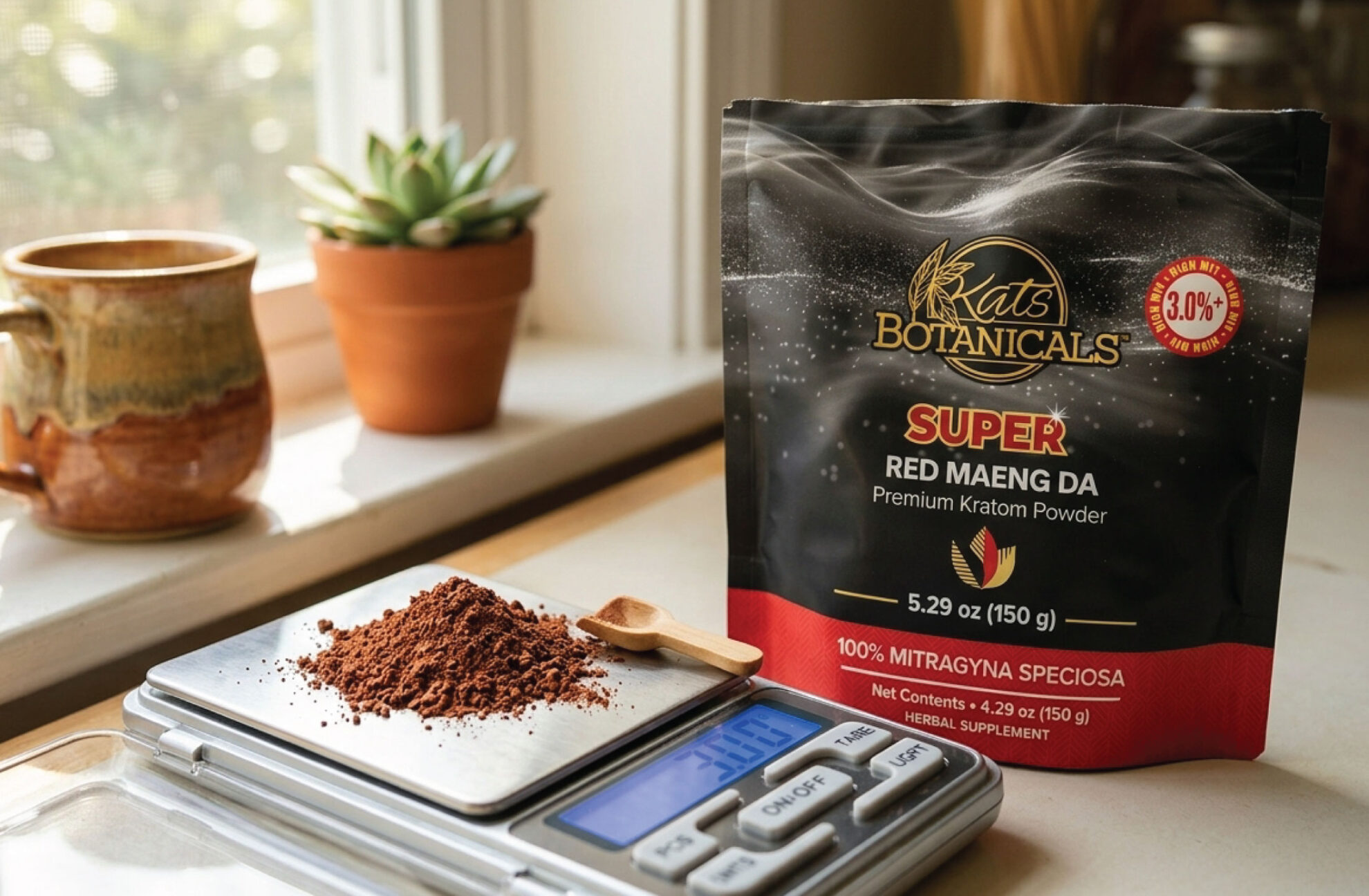
Here is the practical reference. These ranges reflect common starting points for red vein kratom and assume you’re new to that specific product, not that you should climb to the top of the range on day one. For a broader look across strain colors, our kratom dosage guide covers general starting points too.
| Product Type | Beginner | Moderate | Experienced | Notes |
| Red powder | 1–2 g | 2–4 g | 4–5 g | Easiest to measure precisely with a scale |
| Crushed leaf | 2–3 g | 3–5 g | 5–7 g | Often used for tea; measure by weight, not volume |
| Capsules | 2–4 caps | 4–8 caps | 8–10 caps | Each capsule holds roughly 0.5 g |
| Tablets | Follow label | Follow label | Follow label | Check per-tablet weight; it varies by brand |
| Extract (powder/shot/gummy) | Fraction of label serving | 1 serving | Per label | Start well below powder amounts |
The single most important row is the last one. Extracts concentrate the alkaloids, so a serving that looks small can carry the equivalent of several grams of leaf powder. If you only take one thing from this chart, let it be that extracts and powder don’t share a scale.
Safety note: These are educational reference ranges, not prescriptions. Individual responses vary widely, and you should talk with your healthcare provider before adding any botanical to your routine.
Why Red Vein Kratom Calls for Its Own Chart
Red vein kratom earns a separate conversation because of what is inside the leaf and how that shifts the way people dose it. The active compounds in kratom are alkaloids, and the two that get the most attention are mitragynine and 7-hydroxymitragynine. Red veins are harvested from more mature leaves and typically go through longer drying, which is part of why they’re associated with a mellower, more grounding profile than white or green veins.
Alkaloids and why the leaf matters
Mitragynine is the most abundant alkaloid in kratom leaf, and its concentration is exactly why potency varies from batch to batch and strain to strain. A 2020 survey of 2,798 kratom users published in Drug and Alcohol Dependence by Garcia-Romeu and colleagues at Johns Hopkins found that self-reported dosing habits ranged widely, which lines up with what any honest dosing guide has to admit: there is no universal gram count that works for everyone. The alkaloid load in a given red powder can differ from another red powder harvested six months later.
This is where third-party testing earns its keep. A lab report that lists mitragynine content by percentage tells you far more about how a red strain will behave than the strain name printed on the bag. The American Kratom Association’s GMP Standards Program requires participating vendors to pass an annual independent audit covering manufacturing, testing, and labeling practices. If a product doesn’t come with that kind of documentation, you’re dosing blind, and no chart can fix that. Our own kratom lab testing overview walks through what a legitimate certificate of analysis should show.
How your own factors shift the dose
Body weight, metabolism, tolerance, and whether your stomach is empty all move the needle. Kratom’s oral half-life is estimated at around 24 hours in some pharmacokinetic modeling, though the felt effects come and go far faster than that suggests. Practically speaking, that means the amount you take today interacts with how much you took yesterday. Someone who uses red kratom daily will feel a given dose differently than someone reaching for it once a week. If daily use has flattened your response, our guide to managing kratom tolerance covers rotation and reset strategies in more depth. Start low regardless of what a friend takes, because their tolerance isn’t your tolerance.
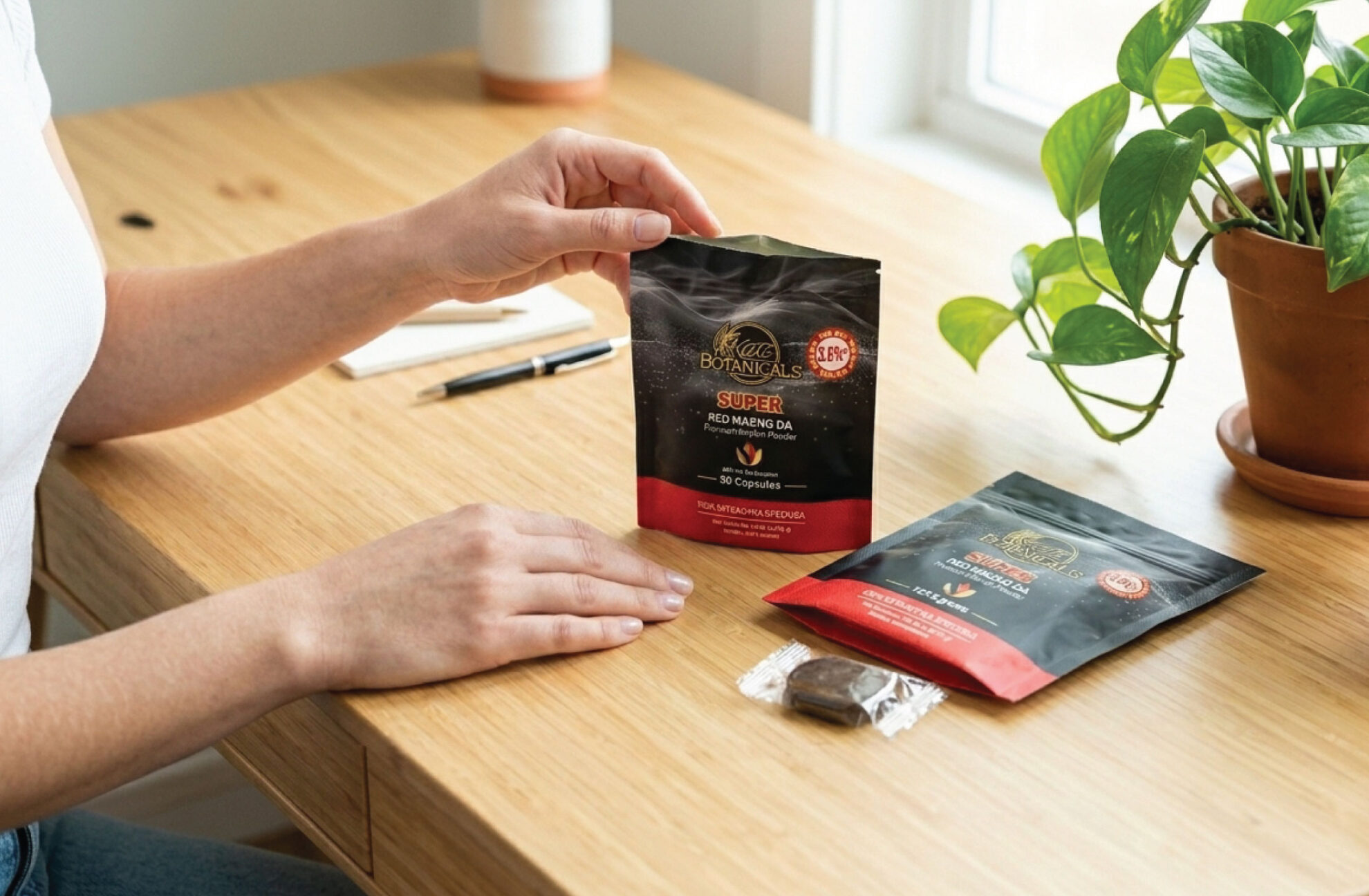
Dosing Different Red Kratom Products
The product format is the variable most people underestimate. Same strain, same brand, wildly different serving math depending on the form.
Red powder and crushed leaf
Loose red powder is the most flexible format because you can measure to the tenth of a gram with a small kitchen scale. If precision matters to you, and with kratom it should, powder is the honest choice. Skip the “teaspoon” method. Density varies enough between strains that a level teaspoon of one red powder can weigh noticeably more than another.
Crushed leaf is the coarser cousin, favored for brewing red kratom tea. It generally calls for slightly higher weights than fine powder because some alkaloid content stays bound in the plant material during a quick steep. Weigh it the same way, and expect a gentler onset when you drink it rather than swallow it.
Capsules and tablets
Capsules trade precision for convenience, and that’s a fair trade if you value not tasting the powder or measuring at all. The trade-off is arithmetic. A standard “00” capsule holds close to 0.5 grams of red kratom, so a 2-gram serving is roughly four capsules. Bulk kratom capsules make daily use simpler, but they also make it easy to lose count, so it helps to portion them out ahead of time rather than dosing from the bottle.
Tablets are less common and less standardized. Per-tablet weight isn’t consistent across brands, so the only reliable move is to read the label for the milligram or gram content and do the same math you would with capsules. Never assume one brand’s tablet equals another’s.
Extracts, shots, and gummies
Red kratom extracts are the format that sends new users past their intended amount, because the whole point of an extract is concentration. An extract shot or gummy may deliver the alkaloid equivalent of several grams of leaf in a serving the size of a swallow. The guidance here is genuinely simple: start low, go slow, and treat the label serving as a ceiling, not a starting point. If you’re used to red powder, don’t port your gram habit over to extracts. Begin with a fraction of a serving and see where you land before adjusting.
Building a Sensible Red Kratom Routine
A workable routine is built from the bottom up, not the top down. Pick your product, find its low-end amount on the chart, and stay there long enough to know how your body responds before you change anything.
Start low and give it time
Take the beginner amount, wait, and pay attention. Red kratom onset by the oral route is often felt within 20 to 40 minutes, so there’s no reason to redose in the first 15 minutes because “nothing happened yet.” Chasing an effect by stacking doses close together is the fastest way to overshoot.
Keep tolerance in view
Using the same red strain every day at the same amount tends to flatten its effect over time, which nudges people toward larger doses. Rotating strains or building in days off can keep your baseline honest. This isn’t a dosing trick so much as basic maintenance. If you find yourself needing more and more to feel the same thing, that’s worth a pause and a conversation with your doctor rather than another scoop.