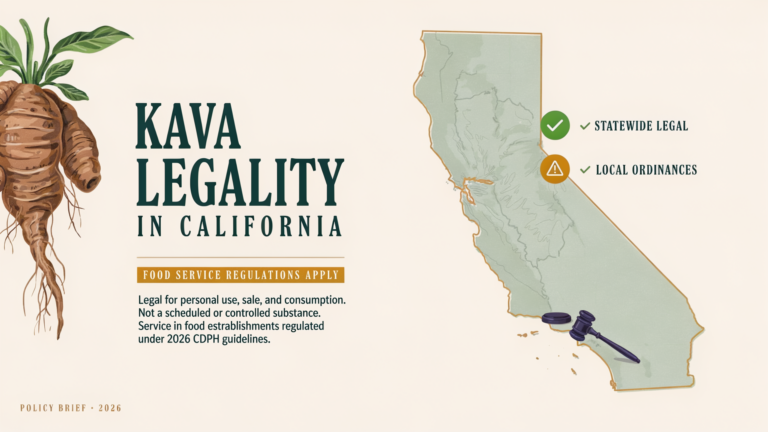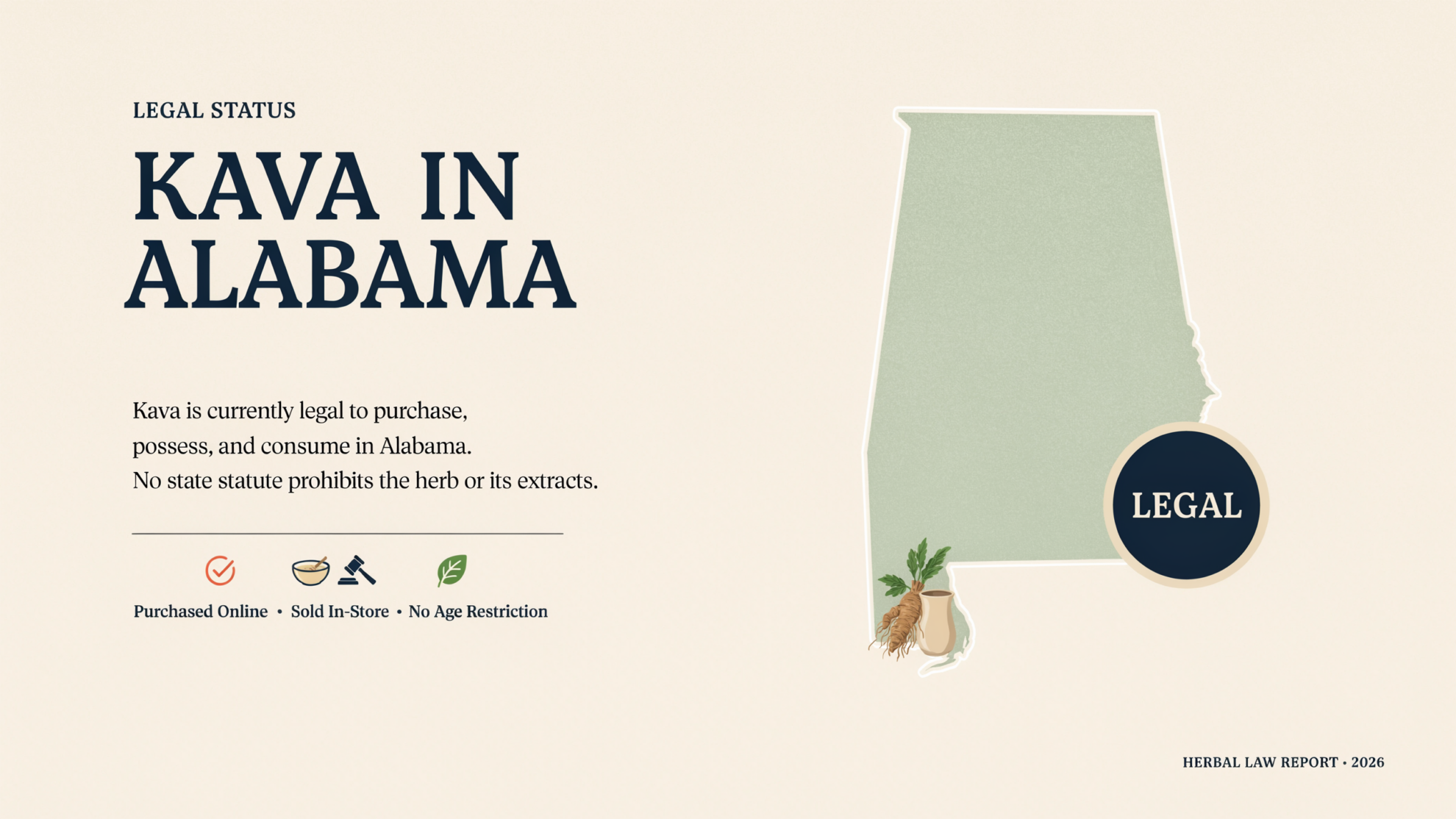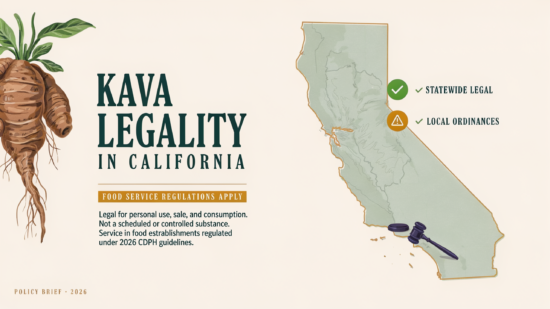
Yes, kava is legal in California in 2026. You can buy it, drink it, and possess it, and businesses can sell it, none of which puts you on the wrong side of any controlled-substance law at the federal or state level. The confusion floating around search results and social media comes from a single mistake: California actually answers three separate questions about kava, and they don’t all get the same answer. Drinking a kava beverage at home is one situation. Selling a bag of kava powder as a supplement is another. Serving brewed kava across a bar counter is a third, and it’s the one that trips people up.
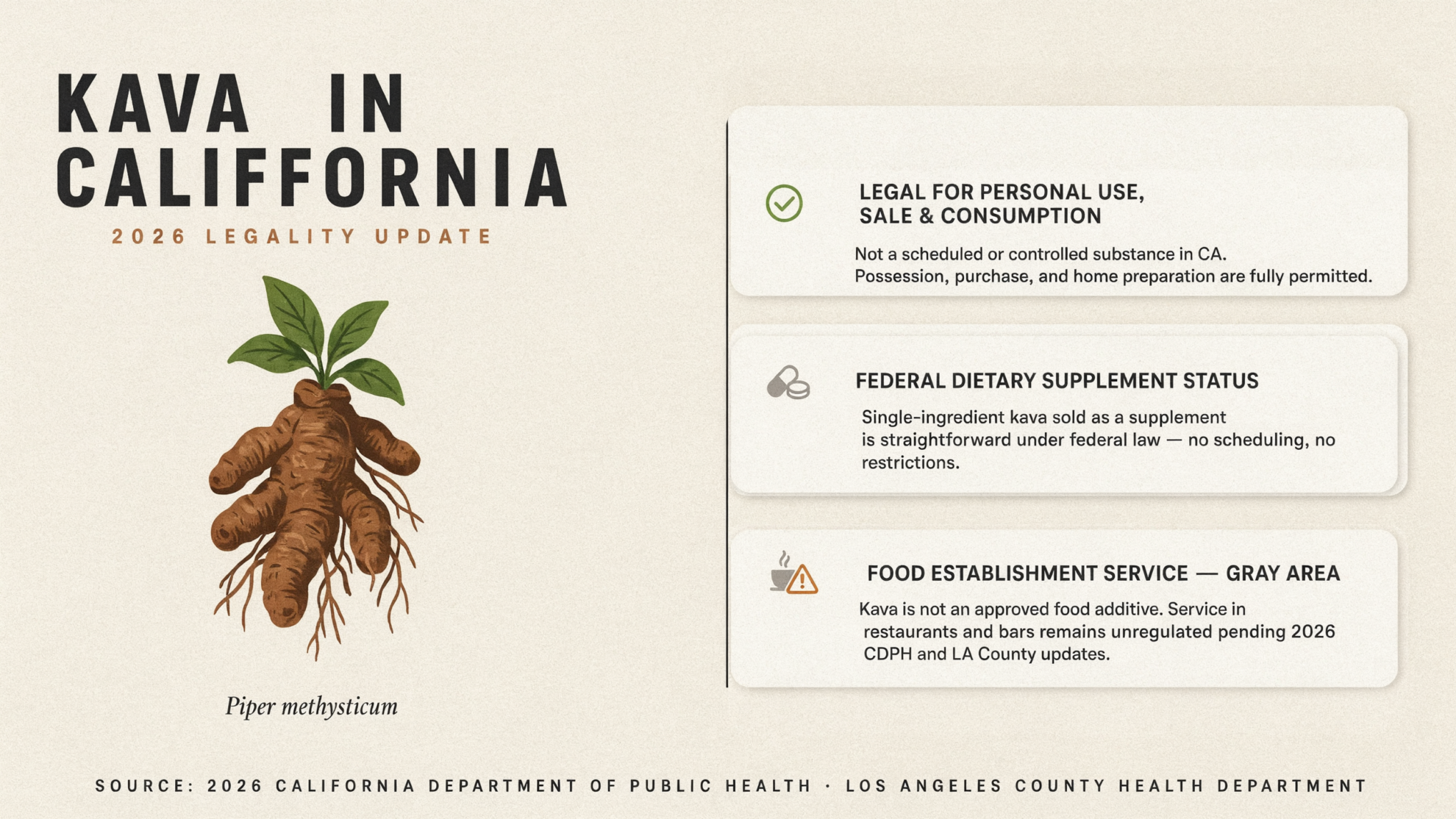
Quick Answer: Kava is legal in California for personal use, sale, and consumption in 2026, and it’s not a scheduled or controlled substance. Single-ingredient kava sold as a dietary supplement is straightforward under federal law. The gray area is service in food establishments, because kava isn’t an approved food additive, which is what the 2026 California Department of Public Health and Los Angeles County updates address.
The Short Answer: Is Kava Legal in California in 2026?
Kava is legal to purchase and drink anywhere in California, with no age law written specifically for it at the state level and no scheduling under drug law. What varies isn’t whether kava is legal but which regulatory rulebook applies to a given use of it: dietary supplement rules, or the food-safety rules a restaurant or bar operates under. That distinction is the whole story, and it’s why two people can read the same government page and walk away with opposite conclusions.
Kava’s Federal Legal Status
Federally, kava is treated as a botanical dietary supplement, not a drug and not a controlled substance. It appears nowhere on the federal Controlled Substances Act schedules, which is the list that governs things like restricted narcotics. Under the Dietary Supplement Health and Education Act of 1994, a plant like kava can be sold as a supplement without pre-market drug approval, so long as the seller doesn’t market it as a cure for a disease. That legal framework is the same one that covers most herbal supplements on a pharmacy shelf.
California’s State-Level Position
California adds no separate ban or scheduling on top of the federal position. The state follows the same supplement framework and, per the California Department of Public Health, treats kava as a legal botanical for sale and consumption. Where California asserts itself is in food safety, since cafes and kava bars fall under state and county health-code oversight. That’s the layer where kava’s legality stops being a simple yes and starts depending on exactly how a business is using it.
What Changed in 2026: The CDPH and Los Angeles County Updates
The 2026 updates didn’t make kava legal, because it already was. What they did was clarify the boundary between selling kava as a supplement and using it as a food ingredient, and that clarification is what set off the online reactions. Two documents are doing the heavy lifting here, one at the state level and one at the county level, and reading them together resolves most of the contradictions people run into.
CDPH’s Updated Consumer Facts Statement
The California Department of Public Health published an updated consumer-facts statement on kava in 2026 that restated the plant’s legal standing while drawing a sharper line around food use. In plain terms, the statement confirms that kava isn’t banned and can be sold, and it points out that kava has not been approved by the FDA as a food additive for conventional foods and beverages. That single sentence is the source of the “is it legal or not” whiplash online, because a social media post or a forum comment tends to quote half of it. The updated CDPH guidance now specifies that kava steeped only in water and consumed as a single-ingredient conventional food would generally not be regulated as a food additive, which is the piece most people miss.
The Los Angeles County Public Health Notice
The Los Angeles County Department of Public Health issued a notice in 2026 that applied the state’s guidance to local food establishments specifically. County health departments enforce food code on the ground, so this notice matters most to kava bars and any operator adding kava to a menu item. It reinforced the food-additive point at the operational level: a business preparing and serving kava-containing drinks is under food-safety jurisdiction, and how it handles the ingredient determines whether it stays compliant. If you want the exact language, the LA County notice to retail businesses regarding kava is published directly by the county, and it reads as an addition to the state guidance rather than a replacement for it.
Three Legal Questions California Answers Differently
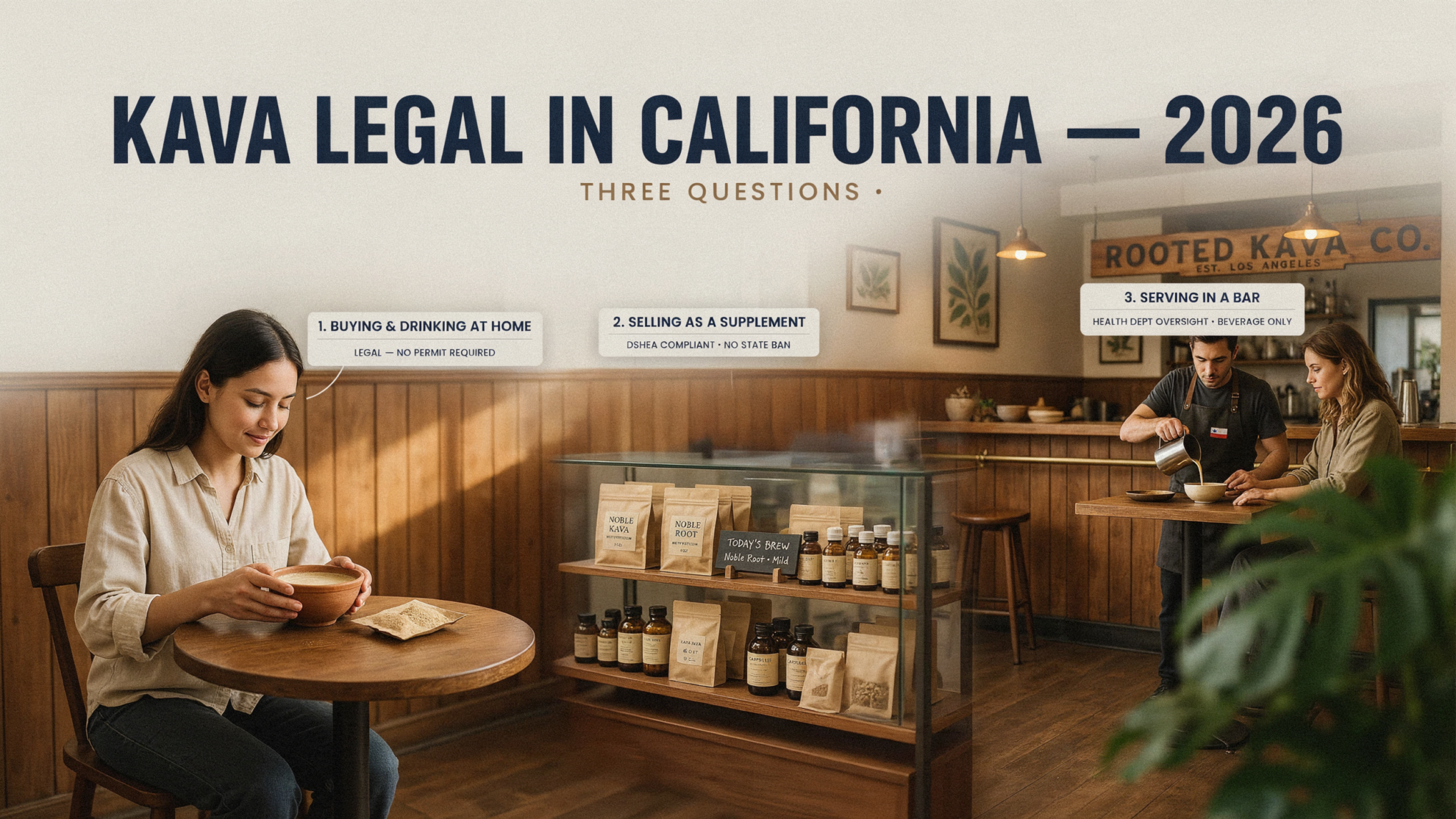
Almost every page that ranks for this topic blurs three questions into one, and that’s the core reason readers leave more confused than they arrived. Separating them is the fastest way to get a real answer for your situation.
Buying and Drinking Kava as a Consumer
If you’re a consumer, this is the easy one. Buying kava and drinking it at home are both legal in California in 2026, with no permit and no special paperwork. You can order kava powder or a prepared kava drink and consume it exactly as you would any other supplement. There’s no state law setting a minimum age to purchase kava itself, though individual retailers and kava bars often set their own 18-plus or 21-plus policies, so the “is kava legal under 21” question usually comes down to a store’s rules rather than a statute.
Selling Kava as a Packaged Supplement
Selling kava as a packaged dietary supplement is legal in California, and this is where most retail sits. A sealed bag of single-ingredient noble kava root, or capsules and extracts labeled as a supplement, falls squarely under the DSHEA supplement framework. The seller’s obligations are the ordinary ones for any supplement: accurate labeling, no disease claims, and honest ingredient disclosure. Nothing about California law singles kava out for a special sales prohibition.
Serving Brewed Kava in a Bar or Restaurant
Serving brewed kava in a bar or restaurant is legal in California, with a catch that depends on preparation. A kava bar operating as a food establishment is under health-department oversight, and the sensitive point is whether kava is served as a straightforward beverage or blended into other food and drink items. Serving prepared kava root as a drink is generally accepted. The moment kava becomes an added ingredient in a broader menu product, the food-additive question from the CDPH statement comes into play, which is exactly what the LA County notice was addressing.
The GRAS Rule That Trips Up Kava Sellers
The phrase creating most of the confusion is “generally recognized as safe,” or GRAS, and the honest summary is that kava doesn’t hold GRAS status as a food additive with the FDA. That sounds alarming until you understand it changes almost nothing for a consumer or a supplement seller, and quite a lot for a food operator. GRAS is a food-additive category, not a supplement category, so a plant can be a legal supplement while still not being an approved additive for conventional foods.
Single-Ingredient Kava vs. Kava Mixed Into Other Drinks
Single-ingredient kava, meaning kava root and nothing else, sold and used as a dietary supplement, sits comfortably in supplement rules. Kava mixed into other foods or beverages as a manufactured ingredient is where the food-additive standard applies, and because kava lacks GRAS status for that use, an operator can run into a health-code problem. It’s the same plant. The difference is entirely in whether it’s being treated as a standalone botanical or folded into a food product, and that framing is what the social captions and forum posts keep garbling.
What This Means if You Run or Visit a Kava Bar
If you run a kava bar, the practical read is that traditional preparation of kava as its own beverage is the safer footing, while building kava into cocktails or blended menu items invites the food-additive question your county health inspector will ask. If you’re a customer, you don’t need to worry about your own legal exposure at all; ordering and drinking kava at a bar is legal for you. The compliance burden sits with the operator, not the person on the stool.
Buying Kava Online or Bringing It Into California
Ordering kava online for delivery to a California address is legal, and it’s how most people buy it. The thing worth checking is the label rather than the legality. A compliant product should read as a dietary supplement, list kava or kava root as the ingredient, and identify the plant as noble kava. Noble kava refers to the traditional, well-studied cultivars, and reputable sellers state it plainly along with third-party lab testing results.
For anyone importing kava commercially or bringing larger quantities in, expect standard supplement-import documentation and requirements that can shift, so verifying current rules directly with the FDA’s dietary supplements guidance before shipping is the sensible move. As a general note that has nothing to do with kava’s legal status: impaired-driving law in California applies regardless of whether a substance is legal, so a legal product never becomes a license to drive impaired. That principle holds for kava the same as it does for anything else.
Where Kats Botanicals Fits In
For readers looking at the single-ingredient side of all this, the Kats Botanicals kava collection is built for exactly that purpose. It features authentic noble kava sourced from the Pacific Islands, available as kava powder, root extract, softgel capsules,tincture, and ready-to-drink formats. Because these are single-ingredient noble kava products presented as dietary supplements, they line up with the clearer, less complicated side of California’s rules, and Kats Botanicals lab tests the kava that goes into them. It’s a straightforward example of the compliant, transparently labeled product this article keeps pointing to.