
Shilajit and ashwagandha are two of the most asked-about supplements in the wellness community, and many people want to know if they work together. Both have long histories in Ayurvedic practice. Both have a meaningful body of modern research behind them. And the mechanisms behind each are different enough that stacking them isn’t just doubling up on the same effect.
This guide covers what each does, how they overlap and where they don’t, what stacking them looks like in practice, and when picking one over the other might make more sense. The two are useful on their own, and useful together for some specific reasons, and the way you take them matters.
Quick Answer: Shilajit and ashwagandha can be taken together because they act on different systems. Shilajit (250-500 mg daily) supports mineral delivery, cellular energy, and recovery, while ashwagandha (300-600 mg standardized extract) modulates cortisol and the stress response. Most users split them: shilajit in the morning, ashwagandha in the evening.
What Each One Does
Shilajit acts on mineral delivery and cellular energy. Ashwagandha acts on the stress response system. They get grouped together in the supplement world because some of the felt effects overlap, but mechanistically they’re doing different things.
Shilajit, in Brief
Shilajit is a mineral-rich substance harvested from rocks in mountain regions, primarily the Himalayas and the Altai range. After purification, the active compounds arefulvic acid (which functions as a mineral chelator and helps move trace minerals across cell membranes), humic acid, and a wide collection of trace minerals.
Modern research on shilajit has looked at hormonal markers in middle-aged men, mitochondrial function, and mineral absorption. A2016 randomized, double-blind trial published in Andrologia of 250 mg of purified shilajit twice daily over 90 days reported measurable increases in total testosterone, free testosterone, and DHEAS in men aged 45 to 55. Studies onphysical recovery andjoint comfort have used 250 to 500 mg daily.
Many studies have analyzed shilajit’s effects in men, but there’s also research on hormonal markers andshilajit for women.
Users are also curious about what shilajit feels like: a slow, sustained shift in baseline energy and recovery over weeks of daily use. It doesn’t produce an acute kick.
Ashwagandha, in Brief
Ashwagandha (Withania somnifera) is a small shrub whose root has been used in Ayurvedic practice for centuries. The active compounds are a group of steroidal lactones called withanolides, which are believed to drive most of the effects users associate with the herb.
Ashwagandha is classified as an adaptogen, meaning it’s associated with the body’s stress response system. The most-studied effect is on cortisol levels. A2019 trial published in Medicine of 240 mg of standardized ashwagandha extract daily over 60 days reported reduced morning cortisol in adults under chronic stress. Other research has looked at sleep quality, exercise performance, and reproductive markers.
What ashwagandha feels like over time: a smoother stress response, often described as feeling less reactive to small annoyances or work pressure, with potential improvements in sleep depth.
How They Work Differently
The two compounds intersect with the body in different places. Knowing the difference is the foundation for deciding whether stacking them makes sense for your routine.
| Factor | Shilajit | Ashwagandha |
| Primary mechanism | Mineral and fulvic acid delivery | Cortisol modulation via HPA axis |
| Main associated benefit | Energy, recovery, mineral absorption | Stress response, sleep quality |
| Onset of effect | 2 to 4 weeks of daily use | 4 to 8 weeks of daily use |
| Time of day | Morning preferred, with food | Flexible, often evening for sleep support |
| Standard daily dose | 250 to 500 mg purified extract | 300 to 600 mg standardized extract |
Shilajit acts on what you might call the “fuel and infrastructure” side of the body: minerals, cellular energy production, hormone production support. Ashwagandha acts on the regulatory side: how your body responds to stress, how cortisol cycles through the day, how sleep architecture holds together.
The two don’t compete for the same pathways. They don’t deliver the same outcomes. Stacking them makes sense when you want to address both sides at once.
When Stacking Them Makes Sense
Stacking shilajit and ashwagandha makes sense when you want to address both energy and stress at once, since they act on separate systems. The case for taking both:
You want both energy support and stress modulation. This is the most common reason users stack the two. Shilajit handles the energy and recovery side; ashwagandha handles the stress response side. The combined effect, for users who report it working, is described as feeling more capable through the day and more settled by evening.
You’re using them for athletic recovery. Some athletes stack the two during heavy training blocks: shilajit for mineral support and recovery, ashwagandha for sleep depth and cortisol management between sessions. Research support for either compound on athletic performance is limited but has been positive in small trials, particularly for ashwagandha and resistance training adaptations.
You want a starter stack with two well-researched compounds. Both have meaningful (if not overwhelming) research bases, both have well-established safety profiles in healthy adults at standard doses, and both work over time rather than in a single session. For someone building a daily supplement routine from scratch, the pairing covers a reasonable amount of ground without overcomplicating things.
Stacking two supplements at once does make it harder to tell what’s doing what. If you’re new to either, taking one for four to six weeks before adding the other gives you more information about how your body responds to each. Theashwagandha and reishi benefits guide walks through how to evaluate that kind of phased introduction.
When to Pick One Over the Other
One supplement alone makes more sense when your goal sits clearly on one side of the equation. A few situations where that’s the case:
Pick shilajit alone if your main interest is mineral support, daytime energy, or recovery from physical activity. Adding ashwagandha doesn’t strengthen those specific outcomes; it addresses a different side of the equation. Theshilajit dosage guide covers format-specific amounts, but the two main options are:
- Shilajit Resin, which pairs nicely with a liquid form of ashwagandha. Add both to a beverage for stacking their effects in one serving.
- Shilajit Capsules, which can be taken alongside ashwagandha capsules.
Pick ashwagandha alone if your main interest is stress management, sleep quality, or cortisol-related symptoms. Adding shilajit to address those won’t move the needle in any well-supported way.
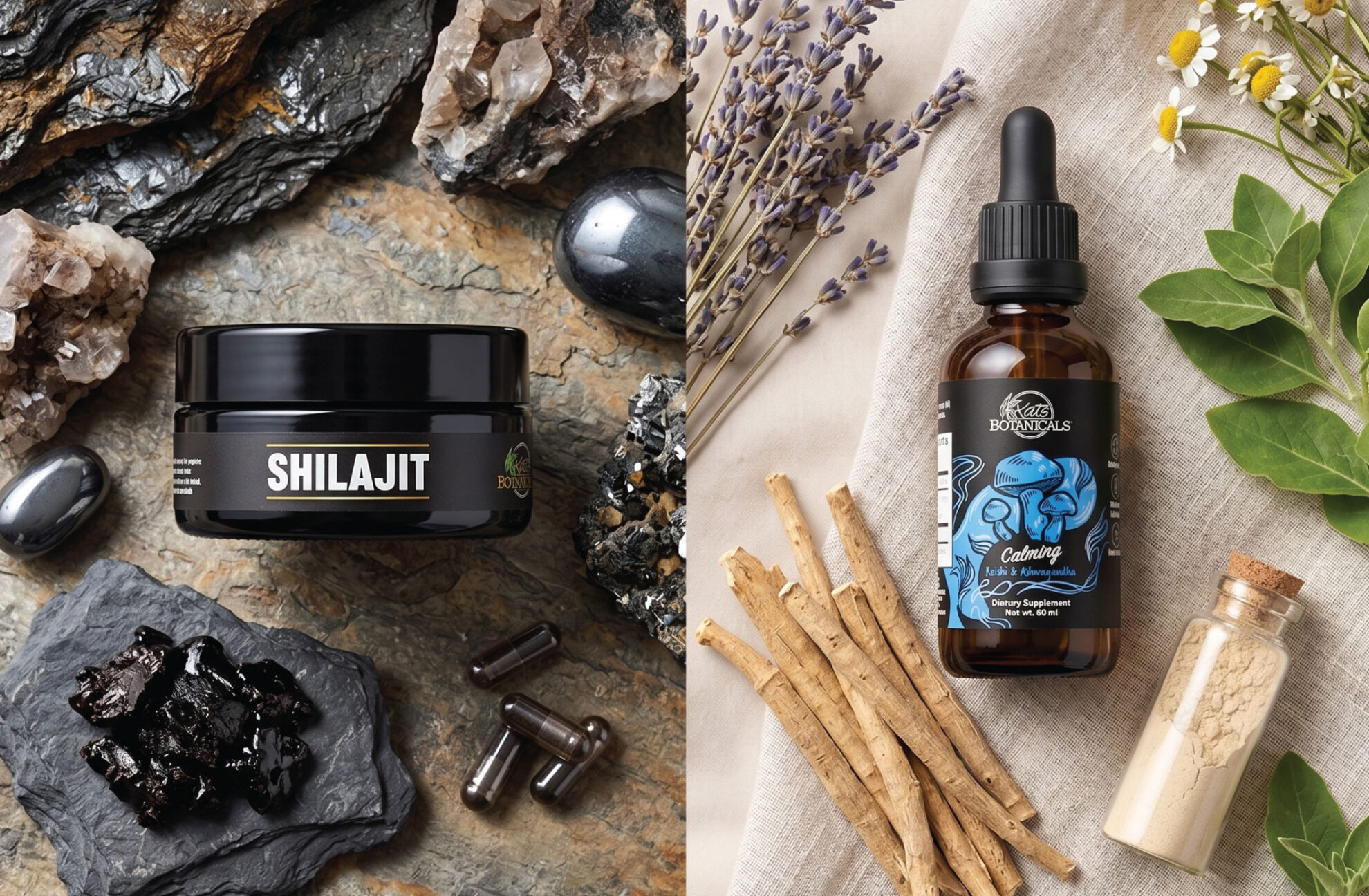
Kats Botanicals offers a combination calming tincture and related calming options:
- Ashwagandha and Reishi Calming Tincture for wind down, calming routine, or stress support.
- Akava vs ashwagandha comparison may also help. While we don’t carry straight ashwagandha at this time, we do specialize inkava products, which appeal to those looking for calming solutions.
Pick neither if you’re already on multiple supplements and stacking more makes it harder to evaluate any of them. Sometimes the most useful change to a routine is removing items rather than adding them.
Pick a healthcare provider’s input if you’re on prescription medications. Shilajit interacts with iron metabolism. Ashwagandha can interact with thyroid medications and immunosuppressants. Neither is dangerous in healthy adults at standard doses, but the interaction profile matters when prescriptions are involved.

How to Stack Them in a Daily Routine
The standard approach is to split them across the day: shilajit in the morning with breakfast, ashwagandha in the evening with dinner or before bed. That timing lines up with each compound’s felt effect and takes advantage of how they act on separate systems.
Morning: Shilajit (250 to 500 mg) with breakfast. The fulvic acid content benefits from being taken with food, and the mild associated energy effect lines up better with daytime than evening.
Evening: Ashwagandha (300 to 600 mg standardized extract) with dinner or before bed. The cortisol-modulating effects of ashwagandha pair well with evening dosing, especially if sleep quality is part of why you’re taking it.
This split isn’t a hard rule. Some users take both in the morning without issue. Some prefer to take ashwagandha twice a day (morning and evening) and keep shilajit to a single morning dose. The key variable is consistency: take both daily for at least four to six weeks before judging whether the combination is helping you.
Track changes one variable at a time when possible. If you’re starting both compounds simultaneously, you’ll feel the combined effect but won’t be able to attribute changes to either compound individually. If your goal is to learn what each does for your body, stagger introduction by a few weeks.
Sourcing Matters for Both
Quality varies widely in both supplement categories, and the spec sheet you should look for is similar across both. Disclosed active compound percentages and third-party lab testing are the two things worth insisting on.
For shilajit: look for purified extract with disclosed fulvic acid percentage on the label, third-party heavy metal testing, and sourcing from a known geographic region (Himalayan or Altai mountain ranges).
For ashwagandha: look for standardized extract with disclosed withanolide percentage. KSM-66 and Sensoril are two well-studied standardized formulations that appear in much of the published research; products using either are typically reliable. Avoid vague “ashwagandha root powder” labels that don’t disclose withanolide content; you have no way to know what dose you’re actually taking.
The Kats Botanicals shilajit and ashwagandha product lines both include disclosed active compound percentages and third-party lab testing. Those are the two specs that matter most when you’re trying to decide between products in either category.